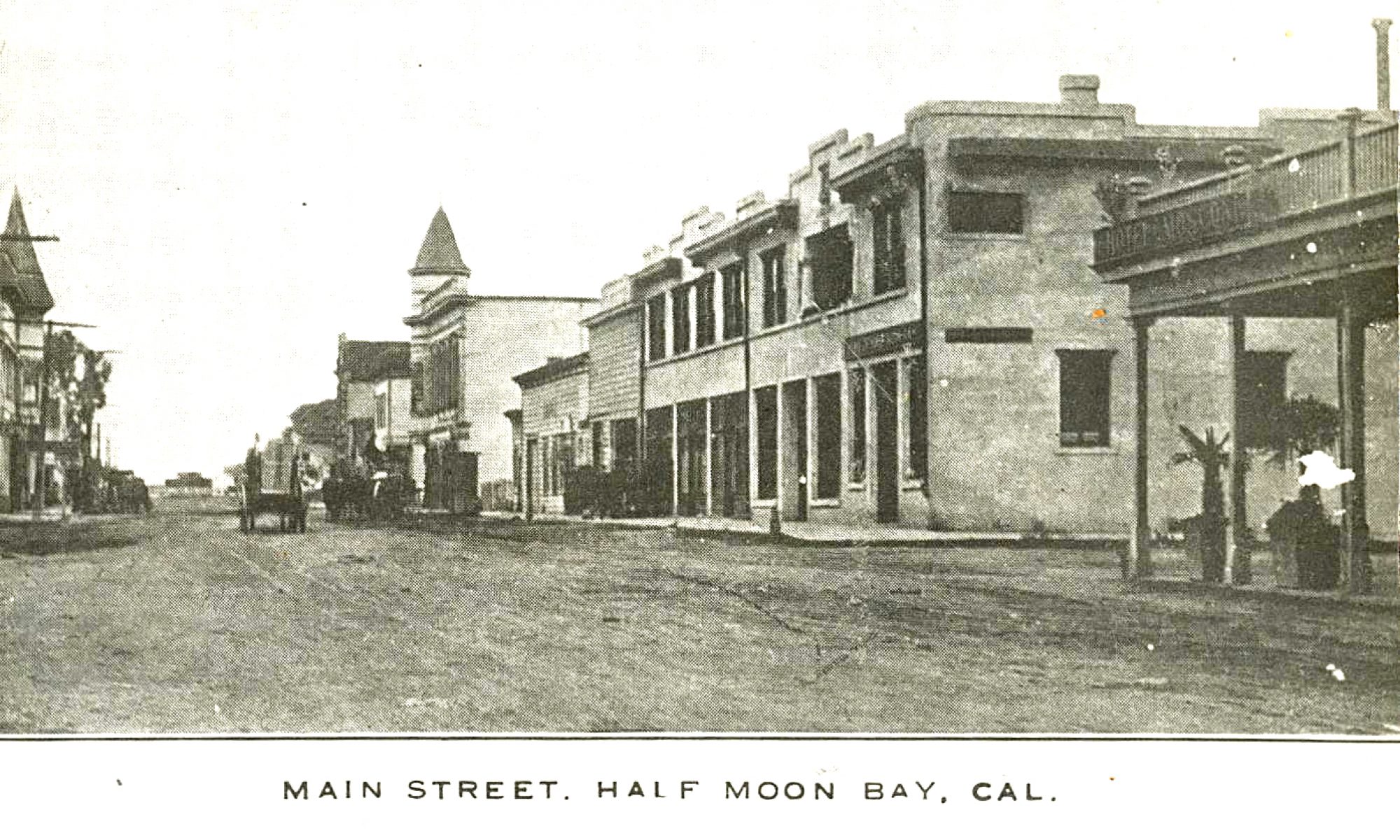
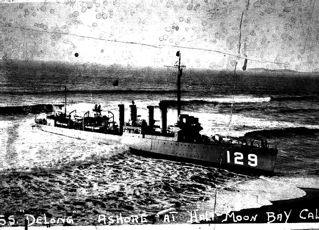
“Realizing the hopelessness of the case, members of the crew have rigged up a cable from a high bluff near the wreck to the De Long and the work of salvaging guns, munitions and valuables has started.
“A.T. Gilcrest of Half Moon Bay returning from the scene of the wreck declares that there was no chance of saving the vessel.
“Pumps are keeping the water from advancing as the crew rushed the salvage work.
“Despite the fact that the engine room is flooded and that there is more than six feet of water in the stern much valuable property is being saved.
“The De Long still stands upright and has not commenced to break- up….unexplained trick of fate the destroyed plowed over two rock reefs undamaged and went high and dry on nthe beach within a stone’s throw of dry land. Big breakers sweep towards her from the rear, but the wrecked war vessel is clear of the pounding surf.”
“The United States destroyer, DeLong probably has found its final resting place on the beach a mile south of Halfmoon Bay.
“Hopelessly grounded in shallow water, with two rocky reefs behind her and hindering her chances of eer being dragged into deep water, Destroyer ‘129’ probably willl remain on the beach to distinegration.
“The powerful sez tugs, Sea Ranger and Sea Monarch, after standing nearby for many hours, have been recalled. They were unable to get a line aboard the stranded vessel. The combined efforts of tugs Sea Ranger, Sea Monarch and Undaunted, and the cruiser Frederick probably would have been futile, as it would be an almost impossible feat to drag the stranded vessel over the two reefs to safety….”
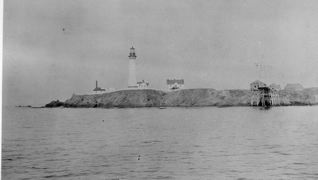
Pigeon Point lighthouse was the private domain of Capt. Marner–a crusty white-haired sea captain who deeply loved ships. From his “white pinnacle” at Pigeon Point, he had spotted the Colombia before the wreck and thought it was the “tender Madrone”–an offical vessel carrying a lighthouse inspector for an impromptu visit.
“I hallooed to my boys,” Capt Marner said, “and they ran to put on their good clothes to recieve the inspector.”
But he soon realized his error as he witnessed the Colombia “lifted by the roll of the sea and dropped again crunching and grinding its nose on the rocks”.
It was a painful sight for Capt. Marner who talked like a man witnessing a good friend’s death.
“Do ya see how she fights for life? Ah, it’s too bad. She won’t let go of the rock,” Marner said. “She’s afraid of going down if she does. She thinks she’ll hold on and live a little longer. But it’s useless. She can’t live, a big rock sticking straight up in her bow and holding her there while the sea whips her tail and rolls her round like a piece of driftwood.”
By the time Lastreto arrived in Pescadero to wire San Francisco for help, the village was buzzing with excitement. While awaiting reply, he sauntered over to the Swanton House where Sarah Swanton, the inn’s famous hostess, insisted on cooking him breakfast.
Emerging from the hotel, Lastreto saw a stagecoach loaded with Pescaderans and city folks, guests at the Swanton House, all headed for the drama at the beach. They welcomed him abord, and when they arrived at the scene of the shipwreck, the fog had finally lifted.
The city folk passed the day picking up the limes that swept ashore and later in the afternoon, a trio of tugs arrived to transport the calm passengers to San Francisco.
The exact cause of the wreck stirred a contentious debate.
“That fog horn must be out of order,” one of the ship’s officers said, referring to the Pigeon Point lighthouse.
“My fog horn was blowing twice a minute all night,” dissented old Capt. Marner.
“It was as faint as if it were miles away,” the ship’s officer continued, “and it sounded far out at sea. The sound came from the west, not from the north. When she struck, Capt. Clark had no idea where he was. The shore could not be seen.”
“This is one of the queerest accidents I ever knew of,” Capt. Marner said, “and I’ve been 35 years at sea.”
Captain Clark said he confused the fog signal at New Year’s Island (Ano Nuevo) with that of Pigeon Point. The two signals stood not far apart and Clark maintained that he thought he was two miles offshore and some distance north of the lighthouse that marked the final resting place of his ship.
The Pescaderans took full advantage of the wreck as a reat quantity of eastern white lead, the prime element of paint, was recovered from the ocean bed. Shortly it was trading at four cents a pound–and according to legend, every house in Pescadero boasted a fresh coat of white paint.
Hundreds of feet of white and gold moulding stripped form the steamer’s staterooms were later fashioned into frames. The salvaged copper wire was used for clotheslines from which hung bolts of satin, blue eans, woolen blankets and quilts. Hat racks, writing desks and other furniture from the Colombia furnished nearby Coastside homes. Kitchen tables were weighted down with granite ware, pots, kettles and tin ware, all from the dead ship.
“The wreckage was so profitable,” a newspaper reported, “that one of the salvagers was able to buy a home in Spanishtown [Half Moon Bay].”
Three months later cases of olive oil still floated ashore. When the Colombia was finally dynamited, Pigeon Point lighthouse’s Capt. Marner grieved for the steamer, telling anyone who would listen: “She was too young to go.”
You might want to add this story from the July 19th, 1896 issue of the San Francisco Call to your Colombia shipwreck info collection. I’ve got a few others I’ll send along about the scavenging, sightseeing boat excursions, etc. I’m glad the name Colombia Cove didn’t stick. Enjoy. John.
COLOMBIA COVE’S WRECK
The Undoing of a Stranded
Liner Viewed by Crowds
of Sightseers.
Souvenir-Hunters Besiege the Vessel
in Search of Relics of the
Disaster.
ON BOARD STEAMSHIP COLOMBIA,
ashore off Pigeon Point Light (via Pesca –
dero, Cal.), July 18.―The wrecking of the
steamer goes on, though tbe bay (they
call it Colombia Cove now) is calm and
the breakers stilled. The ship’s people
know that at any time the waves from a
local blow, or a mountainous swell boating
in from some far off gale will drive tbe
crew ashore and finish the work of the
reef.
Everything that can be moved and re –
moved to the schooners alongside is
wrenched and torn from its fastenings and
hoisted over tbe rail with the still useful
donkey-engine.
That donkey-machine has immortalized
itself. While the great main engines of
the ship lie dead and corroding under
water, the donkey-boiler, perched above
the sea, is in action, and Fireman Collins
is the sooty Casablanca who stays by the
furnace.
When the tide registers high on the
liter-marks on the bulkhead and his fire
sizzles out he drops his shovel, washes his
face in the flood that chases him from his
post and goes up the ladder. Though Col –
lins is a king in a small way. he can stay
the sea no more than did Canute ages ago;
but he gets a good head of steam on before
the water laps over the gratebars and the
faithful “donkey” runs until the tide falls.
Then Collins again starts his fire and lor
a season defies the waves.
One of the foremost laborers in the work
of stripping the steamer is Ship-Carpenter
Wheaton. He assisted in building the
Colombia and is now engaged in undoing
his work. With chisel and crowbar he
ruthlessly wrenches mirrors, desks, wash –
stands, racks and lamps from their places
and tosses them out onto the deck to be
hoisted aboard the awaiting schooners.
He removed the piano from the saloon
yesterday, but with more care than he be –
stows on his other plunder. There are
three other pianos down in the flooded
hold.
The only idle person aboard the Colom –
bia is Customs Inspector O’Leary, who is
here to see that nothing dutiable washes
out through the holes in tie hulk without
his chalkmarks thereon. As he has no
diving suit he is unable to get down into
the hold and prevent the landing of the
cargo, and consequently he is in a quan –
dary. He trusts that Deputy Collector
Bam Rudell will understand the situation.
The only foreign importations that have
escaped him thus far are about 40,000,000
limes that have gone bobbing merrily one
by one through the breakers to the beach
without permission lrom the Treasury
Department. Inspector O’Leary has missed
several cases of men’s trousers from the
ship, which have gone out through the
shattered bottom and have disappeared.
The souvenir fiend has come down upon
the helpless ship. Every article worthless
for practical uses has been picked up,
whether floating or beached, and borne
away to be exhibited in after years as a
memento of Colombia Cove’s last victim.
One woman tourist from Boston found on
the beach a sardine can which Joe Levy of
Pescadeo had thrown away after eating its
contents on the bluff the day before.
An old gentleman hailing from Belve –
dere secured a driftinc beer-bottle and
carried it away in triumph, nor recogniz –
ing it as having accompanied him to the
locality that morning. A sweet Stanford
co-ed risked her life snatching from the
salt sea waves a pocket-comb which her
escort, a football savage, had lost. He
had been combing his long, Samsonian
tresses behind a rock a la mermaid and
had dropped it overboard.
The country swarms with midsummer
campers and the shipwreck is an addi –
tional attraction for them. They come
down tbe beach, sit on the rocks and take
in the marine drama, with the poor Colom –
bia occupying the center of the stage. A
bright sun lights the scene, and the or –
chestral breakers play an eternal mono –
chord. Other ships pass and repass tbe
little bay. gliding smoothly over the quiet
sea, and their freedom makes the condi –
tion of their luckless sister, bound as she
in to a rock, all the more pitiable.
“I was listening to the Ano Nuevo fog
signal sounding off the starboard quarter,
and had not the slightest idea ol danger,”
said Captain Clark to-day, in discussing
the recent disaster. “I was sure that it
was the Pigeon Point warning, and as it
sounded so indistinct in the thick fog I
believed it was miles astern, and so kept
on, with this result. What was my sensa –
tions when I felt the reef?
“Well, it was as if a knife was going
through me. I did not know where I was,
and the shock of finding myself on the
rocks, when I thought myself well at sea,
bewildered me for a few seconds. Then I
thought of the passengers and crew; of
myself I had no thought, except that I
desired to go down on those rocks and be
ground to fragments with my ship.
“I have sailed probably six times a year
for six years out yonder, going up and
down this coast. I knew that this was a
spot to shun, and that it was the burial
place of several vessels that had wandered
in too near the reefs. Can you not im –
agine how anxious I was when the fog
came down upon me, and a danger signal
horn on shore was sounding? I never
THE SAN FRANCISCO CALL, SUNDAY, JULY 19, 1896.
heard the Pigeon Point signal, though it
was so near. If I had caught a note of
that whistle, how quickly I would have
steered for the open ocean, and have pre –
vented this,” and the captain motioned
toward the hull that reeled uneasily
beneath our feet.
“This is my first mishap and no one can
know how it takes me,” he continued.
“My wife and my daughter, the latter of
whom has just graduated from the uni –
versity, are in Massachusetts. They will
immediately return; their pleasant visit –
ing is quickly brought to an end.
But I have one consolation, and that
is that no lives were lost. There is no sad –
ness in any home but my own. I wish
this vessel could be saved. She is too
good a ship to be lost. She was so perfect
in every way that every one who sailed in
her became attached to her.
“Even now the Colombia could be saved
if the proper appliances were at hand.
The water is deep around the narrow ledge
of rocks on which she lies so easily. Ves –
sels, lighters, pontoons of any draught
could be moored alongside of her and her
hull lifted clear. If she had gone ashore
within forty miles of New York or any
large Atlantic seaport she would not have
been abandoned to become a scrap-iron
heap on the beach. When somebody pro –
vides a modern and effective wrecking
outfit the Pacific coast will cease to be a
graveyard for ships.”
Nationally known thespian Wilton Lackaye had awakened in his cabin aboard the steamship Colombia and was dressing for breakfast. Lackaye was a character actor, famous for developing the role o Svengali, the malevolent music teacher who turns an innocent, young milk-maid into a great diva under his hypnotic tutelage. He was en route to San Francisco to do his Svengali in the acclaimed play based on “Trilby”, George du Maurier’s popular romantic novel.
“I knew what had happened,” the 34-year-old Lackaye said, “but I didn’t feel the slightest bit alarmed. Neither did my wife. She knocked on the door and said the ship’s journey was at an end, but that there was no danger.”
While the shipwreck sorely inconvenienced all, there was no panic and no casualities among the 36 cabin and 26 steerage passengers. It was as if nothing extraordinary had happened.
Capt. Clark was philosophical. “As it was destined that I was to have an accident, I thank God that I had such a splendid lot of men and women on board. Why, all I did after I saw we were all right was to tell the ladies that their coffee was waiting beflow and every one of them went down.”
Lackaye seconded the captain’s opinion. “I declare,” he exclaimed, “I never saw such a lot of women in my life. There wasn’t a scream, not a faint, not a prayer, but to tell you the truth, I’ve seen more excitement at the ordinary fire drills at shipboard.”
While meals were served to the stranded passengers, the coffee importer Carlos Lastreto headed toward the stern. He heard the slap, slap, slap of oars on the water, and through the ghostly mist detected the shape of a man in a fishing boat.
Lastreto said, “I hailed the barely visible boatman through the fog.” The man in the boat was a Portuguese fisherman who claimed that he, too, was lost in the fog and he proceeded to climb aboard the Colombia.
After consulting with Capt. Clark, it was decided that Lastreto should accompany the fisherman back to shore and telegraph San Francisco from Pescadero with news of the wreck.
“Luck was with us,” Lastreto later said. As he looked back from the fishing craft, he realized the Colombia had narrowly missing crashing into Pigeon Point itself.
By the time the new steamship Colombia (sailing from Central America to San Francisco) neared Pigeon Point lighthouse, south of Pescadero, the fog was thick–so soupy that it was hard to tell whether it was dawn or dusk.
A foghorn moaned regularly and thinking he knew the route well, the coffee importer Carlos B. Lastreto warne Capt. Clark, the steamer’s captain, that they were fast approaching Pigeon Point–although the fog made it impossible to actually see the lighthouse.
Evidently Capt. Clark thought otherwise. He was convinced the foghorn they heard came from another ship–and Clark briskly walked away, terminating their discussion.
Still sensing trouble, Lastreto wandered forward where he met an old acquaintance, a Pacific Mail Line representative. The two men did not speak but exchanged troubled glances as the heavy gray mist cut off all view of the sea.
When Lastreto heard the repeated distinct sound of the foghorn, this time closer yet, he tensed. The two men turned toward each other, once again without exchanging a word, then walked to opposite sides of the deck expecting the worst.
As the horn blew louder still, grim visions filled Lastreto’s mind. Perhaps seeking safety from what was to come, he headed back to his cabin.
Simultaneously, Capt. Clark realized that the Colombia was indeed in trouble–and that she was heading straight into the breakers.
“Reverse engines,” shouted the captain.
When Lastreto opened the door of his first-class cabin, there was a terrific lurch and the sound of metal grinding on rock as he was flung against the doorjamb.
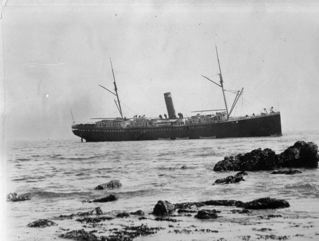
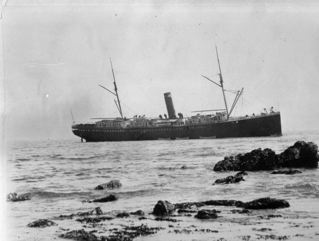
It was 8 a.m. on July 14, 1896 when the Colombia’s bow creaked to its final resting place on the rocky bottom–300 yards from the beach. The Colombia had become wedged between teh rocky claws of a reef half a mile from the Pigeon Point lighthouse.
From the beach, the steamers appeared to be lying at anchor but upon closer inspection, a serrated tear had ripped across the bow–and seawater flooded through the open gash and into the forward compartment.
An avalanche of small limes tumbled out of barrels and floated toward shore.
…To Be Continued…
Photo: courtesy San Mateo County History Museum. Please visit the new galleries at the museum located in the historic Redwood City Courthouse.
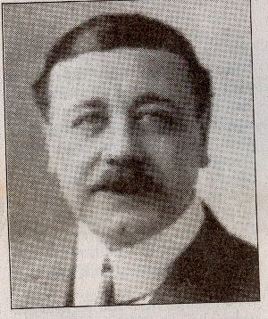
Coffee importer Carlos B. Lastreto frequently commuted aboard Pacific Mail steamers between Central America and San Francisco, all safe, smooth passages. But in the summer of 1896 that changed as the voyage on the new steamer Colombia turned into an odyssey for the future Atherton resident.
Even before Lastreto arrived at the dock in Guatemala to board the Colombia, the prominent 29-year-old San Francisco businessman experienced a dose of bad luck. The evening prior to the voyage his wharfside hotel burst into flames. His clothing, documents and cash burned in the conflagration and spectators suppressed their smiles as the young American fled in his pajamas.
Fortunately, Lastreto had checked a small trunk with the steamship company. Neatly packed in the suitcase were a pair of shiny dancing pumps and a dress suit. During the early part of the sea adventure that awaited him, this formal outfit was all he had to wear, drawing gentle jibes from his fellow passengers and the Colombia’s friendly crew. Lastreto was becoming accustomed to sidelong glances.
From the beginning the weather inhibited the Colombia’s maiden voyage as the journey was immersed in a thick blanket of fog from Cape St. Lucas, at the southern tip of Baja California, until the voyage’s unexpected conclusion. The water and sky seamlessly blended into a wall and vision was limited to 100 yards as the Colombia inched up the California coast to San Francisco, its scheduled destination.
By the time the Colombia neared Pigeon Point lighthouse, south of Pescadero, it was almost 8 a.m. but without a clock it was hard to tell the precise time of day.
As night fell, the crew believed they were 40 miles offshore–but soon discovered they were in the midst of crashing breakers. The “Coya” rammed a reef, rolled over and sank instantly.
Twenty-six of the passengers, including the crew, drowned. Two men and a boy managed to survive by clinging to a rock, then swam ashore for help.
Two years later in November, 1868, a combination of a steel gray sky, gusty, unpredictable winds and heavy seas blinded the ship “Hellespont” as she struggled up the coast carrying one thousand tons of coal.
Captain Soule, a native of Brooklyn, New York, mistakenly believed he was 20 miles off the coast when the “Hellespont” was engulfed by the breakers and crashed into the black reefs.
As the breakers swung the “Hellespont” around wildly, the ship split in half–and the main deck was carried out to sea.
Captain Soule and seven of his men perished. The rest of the crew reached help at the Portuguese whaling station at Pigeon Point.
The tragic loss of lives aboard the three vessels contributed to a popular, local movement seeking construction of a lighthouse at Pigeon Point, a project completed in 1872.
——————————————————-
The Cemetery in the Sand Dunes
In the summer of 2001 something white in the sand caught the eye of a hiker as he walked among the wind-eroded dunes near Point Ano Nuevo. There was something about it that made him start digging.
He quickly uncovered a shocking discovery that made him think violence had happened here: Murder.
For there, only inches beneath the sand in front of him, he later told the San Mateo County Sheriff’s Department, there was a skull.
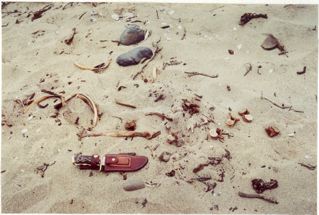
Actually, the sheriff’s investigation would find there were many skulls there and many leg and arm and back and rib bones. Dozens of them. Enough to fill a cemetery.
And indeed, that’s what the hiker had found, a cemetery lost for decades among the shifting sand dunes.
While wrong about this being a murder scene, the hiker was right in surmising that these unfortunates had died violently and the clue was in the roaring of the surf that pounded the nearby beaches.
The sound of the surf is probably the last thing these poor souls heard and is precisely why most of them died.
These dead people had once strode the decks of sailing ships such as the “Sir John Franklin”, the “Coya” and the “Hellespont”.
All perished in the 1860s when their ships, blinded by the heavy fog, struck reefs between Pigeon Point and Ano Nuevo and sunk wuth heavy losses of life. The dead were buried side-by-side in a dunes area originally fenced off and marked with headstones.
The remains of ship’s officials were generally not found at these sites as relatives often claimed them for burial in family plots.
Overtime the strong winds disturbed the sand dune environment, exposing the cemetery site. the shipwreck victims had been buried in redwood coffins–but even this superior wood could not withstand the effect of the sometimes brutal weather and the coffins are now the consistency of wet cardboard.
When I last worked on this story, park rangers were working to stabilize this historical shipwreck gravesite so not to disturb the human remains. A pedestrian boardwalk was to be built with interpretive signs enabling the visitor to learn about the cemetery (and at the same time they will be advised of the laws against disturbing archaeological remains).
Thick fog often hugs the rugged coastline near Point Ano Nuevo–but since 1872 the lighthouse at Pigeon Point has warned ships away from the nasty reefs that had once doomed many a vessel.
Before the lighthouse existed, many ships perished in the fog along that perilous coast, including the sailing vessels “Sir John Franklin”, “Coya” and “Hellespont”.
Without the warning beacon of a lighthouse, all three captains believed they were far enough out at sea, safely away from the spectacularly beautiful but dangerously deceptive coastline.
Carrying a cargo of pianos, dry goods and liquor bound for San Francisco in the winter of 1865, the Sir John Franklin lost her bearings in a dense fog and mopuntainous sea.
The weather cleared–but it was too late to save the “Sir John Franklin”. Caught by the fast moving breakers, the vessel screeched loudly as she slammed into the open fist of the reefs. Upon discovering a gaping hole in the vessel’s hull, all aboard abandoned ship.
The captain, first mate and eleven crew members struggled against the powerful surf but all met a watery death.
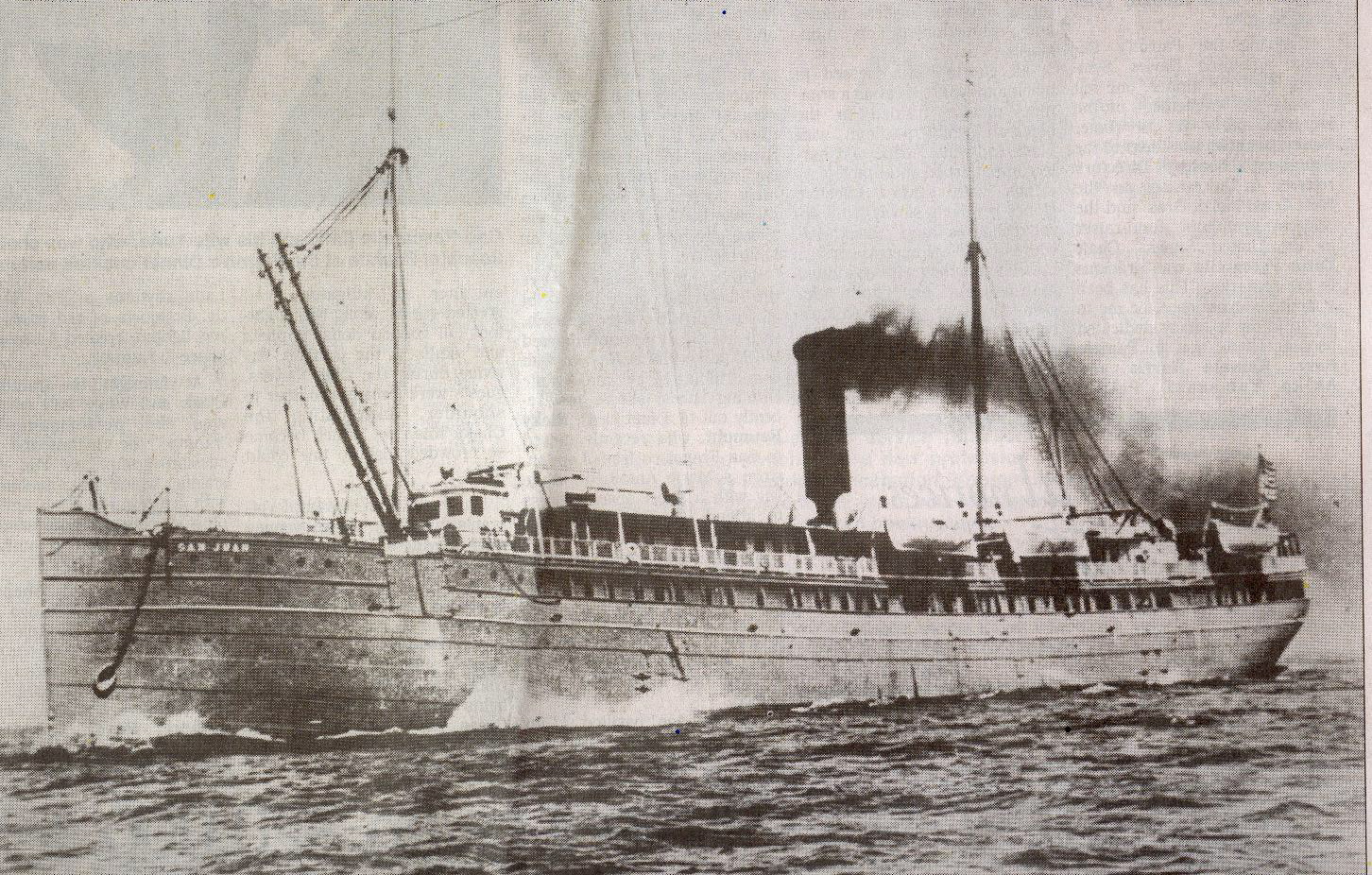
A few posts back I wrote a three-part story about the shipwreck of the San Juan near Pigeon Point in the summer of 1929. Some 72 people died when the San Juan, a vessel that commuted between San Francisco and L.A., was struck by an oil tanker.
It was a horrible tragedy taking the life of Mountain View resident, Emma Granstedt, a wife and mother. Her husband, Theodore, survived but perhaps in a much grimmer way (if that’s possible) than what I found during my research .
Some of Theodore Granstedt’s descendents, including granddaughter Annette Granstedt, read the story at my website and she kindly emailed me the following:
“I was told that my great-grandmother did not want to go on the boat and that when
it wrecked my great-grandfather was found ashore and that he was put in a pile
with the other dead and that someone walked by and noticed he was breathing.”
The rescue ships carried the injured, stunned and stricken survivors back to San Francisco where they were created at the emergency hospital.
Rumor had it that attorneys for the San Juan and the S.C.T. Dodd scurried among the shocked survivors, urging them to keep quiet and avoid reporterâs questions. Clearly the attorneys were less interested in the passengerâs welfare than the liability of the ship owners.
Despite painful abdominal and spinal injuries, Theodore Granstedt could not be dissuaded from talking, charging cowardice on the part of the San Juanâs crew.
âWhen the crash came, the entire crew deserted their posts and saved themselves. They made no effort to launch a boat or save a soul,â? Granstedt said before nurses on the scene convinced him that he was seriously injured and needed to calm down and rest.
Theodore Granstedt had survived what the San Mateo Times called âthe worst maritime tragedy the Pacific Coast had experienced in more than a quarter century.â?
The Times noted that 72 peopleâmost of them passengers, many women and childrenâmet watery deaths as the Standard Oil tanker S.C.T. Dodd rammed the San Juan 12 miles off the San Mateo County coast.
The following day Sheriff James J. McGrath and his deputies patrolled the coastline. Hundreds of curious county residents lined the shore as Coast Guard cutters continued a futile search for more bodies.
As the facts were gathered, the tragic story emerged.
According to survivors on deck at the time, the San Juan was sheared almost in half by thee heavy stern of the tanker Dodd and sank beneath the sea before most of the passengers in their staterooms, and the crewmembers in their bunks, had an opportunity to realize the vessel had been mortally struck.
There were indications that a terrific hole had been torn in the side of the San Juan by the impact and she started sinking at once. When the swirling waters reached the engine room, there was a hissing of steam and then the boilers explodedâshattering the ship from stem to stern.
Most of those fortunate survivors were on the deck or in the saloon at the time of the disaster. Those below in their berths or bunks were doomed.
âIt was not a matter of four or five minutes before the ship sank,â? Charles J. Tulee, the San Juanâs First Mate said. âIt was a matter of only a few seconds.â?
The second mate backed up Tuleeâs version, adding that the vessel sank as he attempted to help some women and children into one of the lifeboats. That lifeboat was the only one that might have been launchedâbut it was shattered in the boiler explosion, hurling the women into the air, injuring many seriously. Only a few survived.
Until the results of an official investigation there was the usual finger pointing. The owners of the San Juan blamed the tanker Todd, listing the heavy blanket of fog that covered the Pacific at the time as a contributing factor.
Just as insistent was the Doddâs Captain Bluemchen, who reported that in spite of the fog, the San Juanâs lights were visible, and that she suddenly changed her course, cutting across the Doddâs pathway.
As Captain Asplund had perished in the disaster, the authorities would never know his version of the events.
Some critics opined that the San Juan was too old to go to sea, but others commented that the steamerâs hull had been inspected by officials and pronounced seaworthy.
Captain Frank Turner, a federal steamship inspector, added that the Titantic was a new ship but she sank almost immediately upon receiving a blow comparable to the one suffered by the San Juan.
The bickering and accusations continued until the official inquiry, including a trial, was completed.
According to reports, the U.S. Steamboat Inspection Service Board found the San Juan inshore of the Dodd, tried to cross the oil tankerâs bow, was rammed and sank within a few minutes on August 29, 1929.
In other words, responsibility for the San Juan disaster was placed squarely on the shoulders of Captain Asplund. This decision did little to mitigate the suffering and loss of life.
The sinking of the San Juan remains one of the worst maritime tragedies that ever occurred off the San Mateo County coastline.
(The End)
Photo: The steamer San Juan, courtesy San Mateo County History Museum, Redwood City