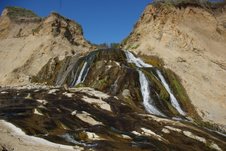
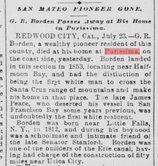
Here’s a story from the July 24th, 1897 issue of the San Francisco Call about the death of the supposed first “white” settler in the Half Moon Bay area, G.R. Borden. Enjoy. John
SAN MATEO PIONEER GONE.
G. R. Borden Passes Away at His Home
in Purissima
REDWOOD CITY, Cal., July 23.— G. R.
Borden, a wealthy pioneer resident of this
county, died at his home at Purissima, on
the coast side, yesterday. Borden landed
in this section in 1853, locating near Half –
moon Bay, and had the distinction of
being the first white man to cross the
Santa Cruz range of mountains and make
his home in that place. Tie late James
Peace, who deserted his vessel in San
Francisco Bay some years previous, was
undoubtedly the first white resident.
Borden was born near L.ttie Falls,
N. V., in 1812, and during bis boynood
was a schoolmate and intimate friend of
the late Senator Stanford. Borden was
one of the builders of the Erie canal, hav –
ing had charge of the construction of fifty
miles near Utica City.
The deceased was extensively engaged
in the manufacture of shingles and was
associated with G. P. Hartley of this city,
forming one co-partnership, and with
R. H. Hatch of the coast side in a similar
enterprise. His real property consists
of a valuable tract ol timber land in
Purissima Canyon which is worth $100,000.
He leaves one son. The burial took place
today at Halfmoon Bay, under the aus –
pices of the Masonic fraternity.
Thanks. I’ve had a change of mind though about the site of the Dougherty’s inn. When I was researching Purisima I read your and other’s stories on HMB, but I missed the continuation of your 1977 story. After reading that I realized only a nut would have built a hotel on the spot I was theorizing was the site after the great flood of 1862 you described. It is just way too close to the creek. It would be a great place to have a cabin though.
There is a new article about Purisima on Wikipedia that links to your website. It’s pretty good.
If you go to Picture 6159 on California Coastal Records Project (CPR), and hit the Comparison button you’ll find 199300128008 between the 2002 photo series and the 1987 photo series. Enjoy. John
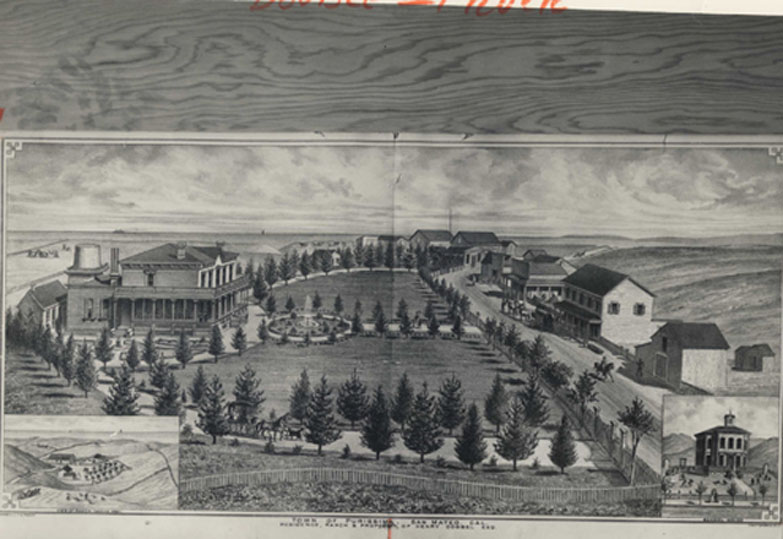
[Image: Town of Purisima (also spelled Purissima), circa 1870s.]
Hi June,
I think you’ll find this an interesting addition to the handful of excellent stories you have posted on HMB concerning Purisima (Purissima). This is an article from “The San Francisco Call,” of April 12, 1900.
Legislation on Fishing in San Mateo
Necessity of Closing Streams Another Month Questioned
On the last day of March, in an article on the trout streams of California the fishing expert of “The Call” commented adversely on the action of the Supervisors of San Mateo in passing an ordinance closing the fishing season until May 1. It was held that as all the fish have spawned by April 1 the closing of the season will be but of little benefit. As none of the adjoining counties have such a law, confusion to the anglers is sure to develop. The editor of “The Coast Advocate” of Halfmoon bay (sic) comes valiantly to the aid of the Superviors. (sic) Unfortunately, for him his argument is weak, as his various premises are not accurate.
The controversy was submitted by The Call to John P. Babcock, chief deputy of the California State Fish Commission and an authority on the game and food fish of the coast. Mr. Babcock supports unqualifiedly the statements of The Call in an interesting communication. He says:
The Coast Advocate is in error in saying that the “Purissima Creek is the most important trout stream in San Mateo County, and that it is not surpassed as a fishing ground by any stream in California.” The Purissima Creek does not compare favorably as a fishing stream with the San Gregoria, (sic) the Pescadero, or Butana, (sic) or their main tributaries.
The fish in the Purissima are numerous, but small. An eight-inch fish is a big one in that stream, and one of ten inches a “whale.”
The Purissima, however, is one of the best known streams in San Mateo County. The wayside inn established some forty years ago by Richard Dougherty upon its bank near its mouth gave it its reputation. “The Purissima House” has no equal of a stopping place on the coast, but it was “Dick’s” care for travelers and his wife’s cooking that made it so attractive. The fishing for small fish was good. They were of fine flavor and Mrs. Dougherty knew just how to cook them and just what to serve with them. Any one who was so fortunate as to eat a meal prepared by Mrs. Dougherty talked of its excellence for days after.
As time went by it was noised about that you must have fished the Purissima to know the real joy of angling, so that at any time in the early part of the season you were sure to find congenial sports there, and even though there were no fish over eight inches in length your catch from the Purissima, you came home, well convinced that fish do not contribute all of “fishing.” It is curious how the fish did get into the Purissima and how they maintain themselves there, for they cannot enter from the sea, and up to the time of Dick Doughtery’s death a few years ago as far is known the stream was not stocked with fish from any other water. Yet year after year fish continued to multiply and furnish creel after creel of small trout to the anglers who visited its water. As to the spawning period of the fish in the Purissima the writer is not as well informed, but they “do not entirely cease spawning until after May 1 and not a third have completed their work by April 1st” as the Coast Advocate says. The wonder of them maintaining themselves in such a limited water course is more the mystery.
In all the thirty odd years Dougherty lived there the stream was fished each year by hundreds. When a stream will stand such a strain for such a length of time one may well believe that Dick was right when he said, “You can’t fish ’em all out.”
So far as the writer knows the spawning season of the trout in the Purissima does not differ materially from those other streams in the county, namely, December to April. There may be a few who have not deposited their spawn by April 1, but they are the exception. The embryo of the next season’s spawn is large enough in April to be noticeable. This is true ever of trout that have just spawned.
If the present close season was observed there would be no necessity for a longer season in San Mateo county. It is commonly stated that little or no attention was paid to the closed season this year in San Mateo. It is even stated on April 1 there was a well-beaten track on both sides of San Gregorio and Pescadero Creeks. If the peace officers and Supervisors of San Mateo County would take steps to enforce the closed season under State law it would be of more benefit to the streams and the anglers who go there.
————————————–
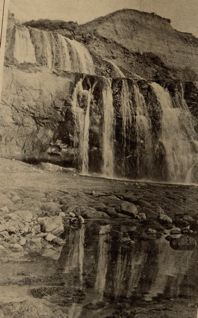
While I’ve been unable to locate any further information about “The Purissima House” or Mr. and Mrs. Dougherty, I believe I have a reasonable answer to how the fish got in the creek. The answer is glaciers. The present sea level that makes the Purisima Falls an obstacle to fish wishing to return to ancestral spawning grounds from the ocean, has only existed for a blink of an eye in geologic terms. As you can see from this map I’ve attached that even ten thousand years ago the sea level was still about 100 feet lower then it is now with the shoreline several miles west of where it is now. The Falls themselves were still covered with softer rock and soil that was washed away by waves as the waters rose to their present level. My guess it was probably only in the last five thousand and possibly much more recently that the falls became an impassable obstacle to the returning fish. It might even have been in just the last thousand years, after the sea level became stabilized, that the forces of erosion, both the stream’s flow lowering the creekbed’s level and the receding coastline caused by the unrelenting pounding of waves, created this wonderful waterfall and gave the stay at home trout genetic dominion over this watershed.
My understanding is that the Cowell/Purisima Trail won’t be open until Spring because of the need to build three substantial bridges, but you can check out this area and the progress they’d made as of Oct by checking out California Coastal Records Project (CCRP) Pictures # 20080795 (Cowell Beach Access Point) south to #200809829 (Poppy Point viewing area) CCRP has recently added two series of looking-straight-down high altitude photos, of which Picture #199300128008 is of the Falls and the nearby area, which certainly must include the site of “The Purissima House,” that the Doughertys made famous. My guess is the bare brown oval just above the Falls was the site, but that’s just because I would have put it there if I was building it. Enjoy. John
————————–
Hi June,
This is a Screengrab of California Coastal Records Project (CCRP) Picture #199300128008 that I added a P to indicate where I think “The Purissima House” was. This leveled spot with the to-die-for view, is somewhat lower then the surrounding land, giving it some shelter from the wind, easy gravity flow water to it and the sound of the stream and falls nearby to soothe you. With all the land on the flat above I can’t think of any other good reason they would have bothered to level this tiny, isolated patch otherwise. Enjoy. John
The Purisima board game we invented was probably a reaction to the landlord shuffle. When we first saw it, the modest little frame house on Purisima Creek Road had a sign saying “Maggie’s Farm” over the front door.
Of course, we all knew the Bob Dylan song of the same name. “I ain’t gonna work on Maggie’s farm no more.”
“Well, I try my best
To be just like I am
But everybody wants you
To be just like them.”
We had jobs. The children went to school. Apart from this, the three families who lived at the farm on Purisima Creek Road were trying our best to be just like we were. We weren’t really farmers, but we pretended we were, with our gardens, overalls, compost bins. We invented our own fun, lacking anything ready-made. We wrote poetry, played the piano, painted pictures.
Before we moved to Purisima Canyon and while we still had television and could watch Star Trek, we had invented a three-dimensional chess game (trying to duplicate the one on the TV show) which was so complicated that nobody could play it. We were used to entertaining ourselves.
The woods at the end of the road, now the 3,361-acre Purisima Creek Redwoods Open Space Preserve, was still wild and there were no houses about. We loved to walk to the end of the road and back, passing by the part of Purisima Creek where the bachelor flock of mallards hung out. We would quack back at the ducks, collect miner’s lettuce, admire the wild roses.
We rehearsed choral numbers together, shared produce, planted a garden, kept a joint journal about the motley flock of chickens. We made plum jam, plum wine, plum leather. The kids played gopher golf with a set of clubs they found at the dump (one day an archeologist may wonder why there are so many golf balls a foot or more beneath the earth surface.)
We cheerfully waded through the mud to get to the chicken coop and each other’s houses. We parked our rubber boots at the front door.
After we ran out of buckets and house plants to put under the leaks, we put a new roof on the house. When the tap water stopped, the fellows would hike up to the spring to clean out the leaves.
At first, we paid our modest rent checks to a bank, since the farm was in probate.
Then the Evil Landlord bought the 350 acres with its tumble-down shacks, barns, and pens and immediately raised the rent. He appointed a deputy who told us to remove our stored items from what had been a millhouse and informed us that we would have to move pretty soon.
Work began on converting all the farm buildings into rental units. We laughed about it until we realized that we were ourselves standing between the Evil Landlord and a neat profit which he planned to realize from preserving the rooflines of derelict buildings and making them into houses.
“Why do they call it real estate when it’s so unreal?” I asked a friend.
“It’s a feudal concept,” he said. “It means ‘royal’ estate, from the days when all land was considered the property of the king.”
We invented a board game called Purisima, based, of course, on Monopoly. We drew and painted a kind of loop which included the next canyon over, and we played with a huge wad of toy money and a pair of dice. When we moved from Purisima Creek Road, we gave the game to somebody who would be staying there. Playing the game, we had the illusion of control over make-believe real estate. We shrewdly parlayed our fake money into pretend real properties, hoping to accumulate homes, farms, and lots of animals.
About the only thing I remember about the game is that it had, in addition to Christmas tree fields, meadows, houses, coops and sheds, a plastic rooster which allowed a player to collect more rent. A neighbor called R. Gaines had a plastic rooster in his front yard, much admired by our family. The few houses which were on the road in 1972 were all represented on the Purisima board: There was Bud’s place, Stan’s place, Nancy’s place. Instead of going to Jail, if you lost all your Purisima money and your house, you could go to the Hippie Commune.
It is, of course, very different out at the canyon now. There is the beautiful Open Space Preserve. There is the Elkus Ranch, donated by the Elkus family to the University of California in 1975 and now used as an environmental education center. There are lots of big houses and mown meadows. The buildings near where we used to live are all freshly painted. The present owner has a gated entrance, but she has replaced the mossy old grapestake fence with new weathered grapestake and has extended it all around the fields near the barn, which I think was tasteful.
We all grew up to have our own real estate, all with sound roofs on the houses. Many of us are still in touch with each other. I wrote some of the others and asked if they remembered the Purisima Game, but nobody else recalled it.
(Written in 1977, using the resources at the San Mateo County History Museum)
By the age of 16, Henry Dobbel launched his ambitious climb to the top. That year, about 1845, he ran away from his home in Germany, to seek an adventurous life at sea.
The self-confident youth worked at odd jobs, willing to do anything, earning the respect of everyone around him. All the while, in the back of his mind, Henry knew a rich, full life lay ahead. Sailing around the Cape Horn, he landed in California months before the Gold Rush.
Again, in the Golden State, he performed all kinds of work, including hauling freight between the Amador minds and Sacramento. But soon Dobbel’s enterprising mind inspired him to switch occupations as he used an imported waffle iron to run a successful San Francisco restaurant.
He met and married fellow German Margaret Roverkampf-Schroeder. She arrived in California via the mosquito-infested trip across the Isthmus of Panama on muleback. The couple settled on a large farm in the East Bay.
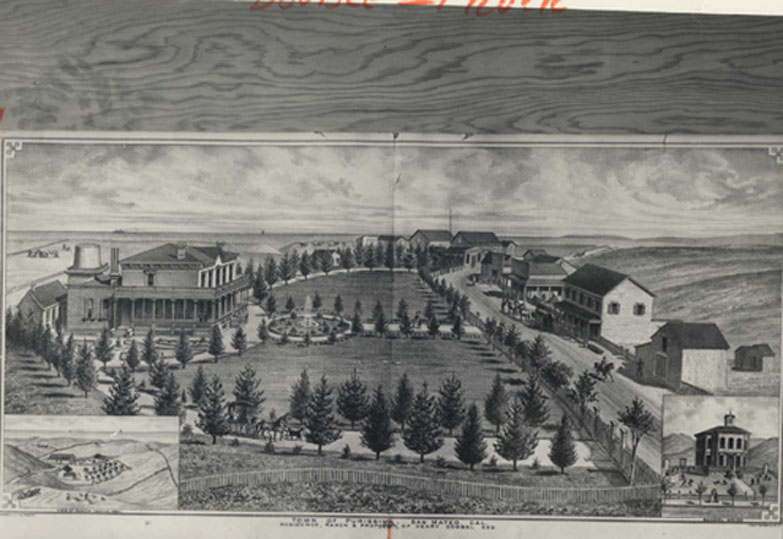
In the 1860s Henry learned of the opportunities at the bustling new village of Purissima, sold his farm, and bought a thousand acres from John Purcell. The Dobbels became one of, or the largest landowners with dreams, perhaps, of being the biggest fish in a tiny pond.
Henry and Margaret built a big house on the south bank of the creek. Carpenters came from San Francisco and stayed for six months to construct the two-story, 17-room imposing building. There were all sorts of civilized conveniences, including running water in the rooms [established via a hydraulic “ram” placed in the creek to pump up the water.] Ever the inventor, Dobbel figured out how to install gas lighting in his new home.
The Dobbel’s created a true “Coastside mansion” with a ballroom covered with carpets imported from New York and Europe. Their dreams of grandeur extended to the gardens where colorful flowers and shrubs surrounded an elegant water fountain.
At all times two vicious mastiffs guarded the house and the valuables inside–as an additional precaution, the Dobbel’s personal police force patrolled the extensive grounds dotted with a smokehouse, gas house, barns and other outbuildings.
The Dobbel’s working ranch employed 50 men who planted and harvested wheat and barley, and potatoes, the mainstay of the area.
My impression is that the Dobbel’s wanted Purissima to be their personal fiefdom, which may not have been that unusual at the time. Consider the many grandiose mansions on the other side of the mountain. Without taxes to pay, it was possible to pursue a lifestyle that was diminished after 1913 when the Income Tax law went into effect.
The Dobbel’s employed schoolteacher Mary Bradley who lived with them. But the local children who attended school only in spring, summer and fall, failed to learn their lessons in winter, when the muddy roads prevented them from reaching the little schoolhouse.
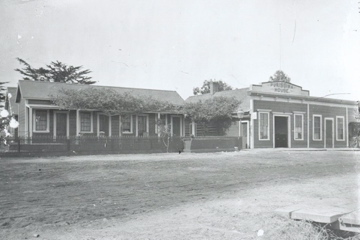
A journalist passing through Purissima in 1871, noted impressive improvements, some financed by Henry Dobbel. The growing town consisted of a wagon, harness and shoemaker shop and Richard Dougherty’s well known Purissima House. Dougherty was the hotel’s host as well as the town’s postmaster where the stage stopped every day.
Half a dozen carpenters worked feverishly to finish the new general store, owned by the Husing brothers of San Mateo. Inside groceries, boots, liquor and cigars were sold. The sign outside read: “Come and see us. We mean business.”
A year later, Purissima was known as an up and coming town, prosperous and promising.
During a stage ride–apparently arranged for the purpose of snooping around Purissima–the visitors described the good-looking farms belonging to George Shoults, J. Campbell, and Silas H. Bowman, whose luscious fruit orchard receiving a special taste-test.
Near the mouth of Purissima Canyon, the snoopers took a tour of the locally famous Borden & Hatch mill, the exclusive suppliers of lumber to Half Moon Bay. There was no time to walk or ride horseback up to S.P. Pharis’ shingle mill, located in the same gulch.
Everybody called Henry Dobbel “the big farmer who paid taxes on $69,400.”
Spurred on by his many successes, Dobbel bought up more Coastside property, all of it near his mansion.One year he rented an 500 acres near the James Johnston house, now a landmark. All of the land was planted in one crop: potatoes.
As Purissima kept proving it could be a real town, businessmen in Half Moon Bay looked to invest in a good thing. A place called “Fairmont Park” was developed for “pleasure parties” in the canyon, not far from the Purissima House and five miles from Half Moon Bay via Higgin’s Road. All pleasure Parties required was dance floor, and swings and tables artfully placed beneath the redwoods.
To top it off, oil was discovered by the Purissima Petroleum Co. on George Shoults’ land in the 1880s–20 barrels a day. And then when, the same company drilled for coal oil at Dobbel’s place, “where a fine flow of oil was struck at 70 feet,” well, the excitement could hardly be contained. Everybody thought there would be an oil boom, along with the arrival of new residents, and construction began on a bigger schoolhouse.
But it was all a chimera, a fanciful dream.
In the middle of all the oil boom talk, Henry Husing, the San Mateo merchant who owned Purissima’s general store, sold out to Henry Dobbel. Dobbel, who knew a lot about many things, didn’t know how to run a business extended credit to anybody. Too much credit. Everything was going out and nothing was coming in. Then began the crop failures. The first year he could put it out of his mind, but the potatoes disappointed every year.
According to legend, Henry Dobbel acted against his nature when he mortgaged his property to the rival wealthy landowner Henry Cowell. At the foreclosure proceedings in 1890, the only bidder on the Dobbel estate was Henry Cowell–a man Coastsiders, when given the chance, loved to outsmart.
A year later Henry Dobbel was dead. Isn’t that the way this kind of a story often ends?
With Henry Dobbel gone, the fire and passion that was Purissima cooled off–meanwhile all the business headed for Spanishtown, now known as Half Moon Bay, and all talk of a town called Purissima faded away.
Purisima, The Town That Could Have Been Half Moon Bay: Part I
(Town of Purisima, circa 1870s, as depicted in the book, “The Illustrated History of San Mateo County,” Moore & DePue, publishers [1878]; reissued by Gilbert Richards Productions, Woodside, California in 1974)
Click on the image to get a bigger picture!
By June Morrall
[I wrote this in 1977, using resources at the San Mateo County History Museum, Redwood City County Courthouse.]
As the first Americans reached “La Costa,” [the coast] in 1853, some purchased land, some lived a simple existence on rented soil–and still others, called “squatters,” ignored the formal rules of land ownership.
When a group of these squatters descended upon the Rancho Miramontes in Half Moon Bay on Sept. 24, 1853, they found Mr. Miramontes’ friends waiting to run them off the land. Unable to defend themselves in the face of strong opposition, the squatters drove off to drum up support.
And–soon, the Americans returned with reinforcements, boosting their number to 40 or 50. During the heated confrontation, the squatters, who caught the Spanish off guard, managed to seize even more land than before. [But, apparently, their victory was short-lived.]
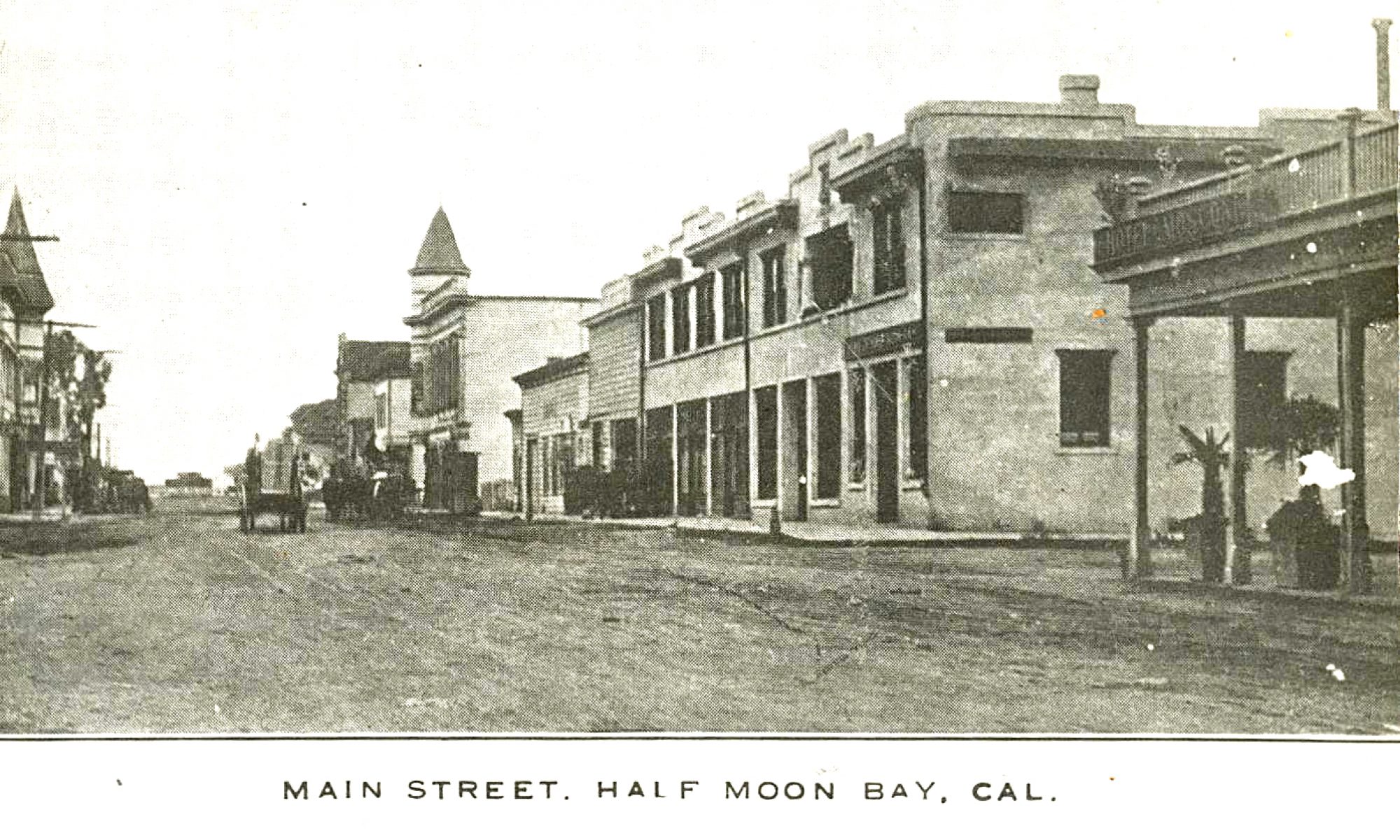
Within a year, some of these Americans–sensing confusion over a narrow strip of disputed land, located between the Canada Verde and Purisima Creek, headed straight for the controversial territory. Merchants, who dreamed of developing a prosperous business district on the north side of Purisima Creek, followed behind.
And in this magnificent rural setting, four miles south of Half Moon Bay, the new village of Purisima rivalled Spanishtown.

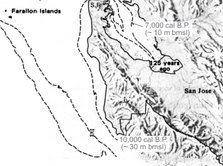 that even ten thousand years ago the sea level was still about 100 feet lower then it is now with the shoreline several miles west of where it is now. The Falls themselves were still covered with softer rock and soil that was washed away by waves as the waters rose to their present level. My guess it was probably only in the last five thousand and possibly much more recently that the falls became an impassable obstacle to the returning fish. It might even have been in just the last thousand years, after the sea level became stabilized, that the forces of erosion, both the stream’s flow lowering the creekbed’s level and the receding coastline caused by the unrelenting pounding of waves, created this wonderful waterfall and gave the stay at home trout genetic dominion over this watershed.
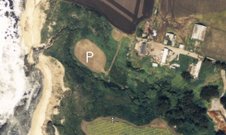 that I added a P to indicate where I think “The Purissima House” was. This leveled spot with the to-die-for view, is somewhat lower then the surrounding land, giving it some shelter from the wind, easy gravity flow water to it and the sound of the stream and falls nearby to soothe you. With all the land on the flat above I can’t think of any other good reason they would have bothered to level this tiny, isolated patch otherwise. Enjoy. John