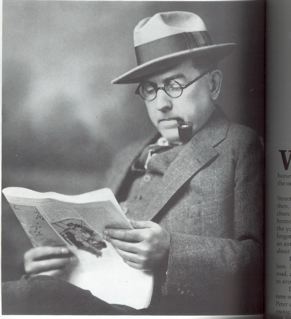
With the creation of his Cappy Ricks character in 1916–the founder of the Blue Star Navigation and the Ricks Lumber and Logging Companies– Moss Beach author Peter Kyne was on his way to becoming a household name.
[The house Peter Kyne grew up in–near Highway 1, at the southern end of MB may still be standing. I’ve misplaced my photo of the two-story yellow house–but I’ll find it for you.]
The Cappy Ricks character became so popular that Kyne’s editors asked the author to travel the world and describe what he saw from Cappy Ricks’ point of view. And it must have seemed a much bigger world than the internet-driven one we are accustomed to today. From any point of view, small town Peter Kyne was a very lucky writer.
To use a sports metaphor, he was in “the zone” and batting in one home run novel after the other. Things got more exciting as Kyne’s book, “The Three Godfathers”– a story about several outlaws who promise a dying woman they will save her baby–was made into a 1948 film directed by John Ford and starring John Wayne and Ward Bond.
The 1919 & 1938 filmed versions of Kyne’s book called the “Valley of the Giants” was about saving the old groves of redwoods in Northern California–a timely plot as there had been a powerful movement emanating from leaders and students at Stanford University to preserve the elegant redwoods of San Mateo County through the founding in the 1920s of Memorial Park in La Honda.
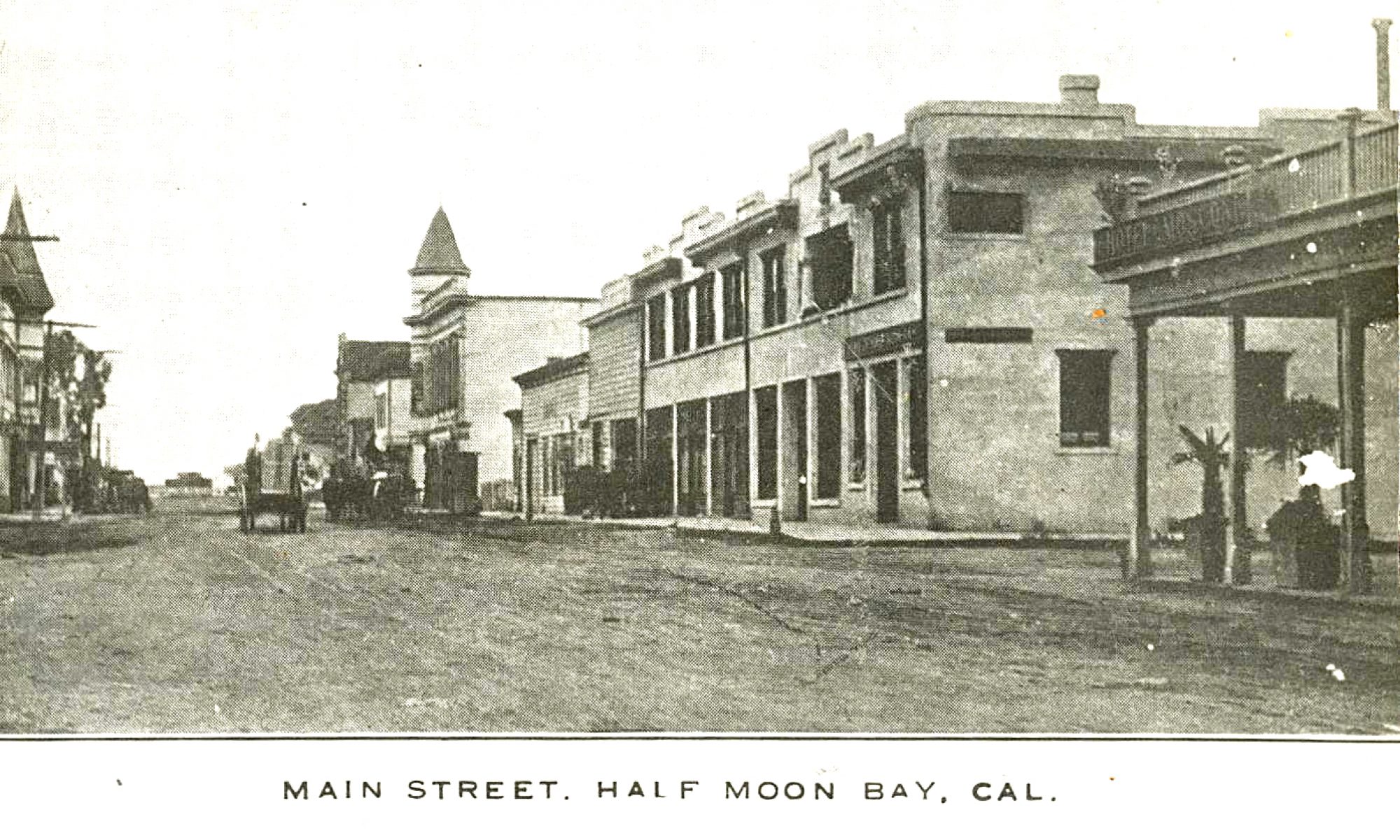
As Peter Kyne became famous, he visited the Coastside more and more rarely. A Half Moon Bay nephew, Gerald Kyne, remembered his Uncle Peter visiting Moss Beach, arriving in a chauffeur-driven automobile. By then he had long lived elsewhere–but those early years on the Coastside had left their mark.
Peter Kyne died in 1957.
==================================
Story from John Vonderlin
Email John ([email protected])
Hi June,
I think the following news article goes
well with your five part essay on Peter Kyne,
and augments its hometown-insider aspects.
I checked Mr. Kyne on Archive.org and there
are 43 hits, but many are repetitious. Still, if
somebody want to read some of Half Moon
Bay’s most prolific author, (am I right?) there
are more then a dozen different titles there to
read for free.
I read a little of his “Three Godfathers,”
(first novel) and found it written in an interesting
style. When I was a kid and loved Westerns, I
would have liked it a lot.
In this article about Peter Kyne’s return to
HMB, from the Spanish-American War, you
can see, that bogus war or not, Half Moon Bay,
knew how to treat its returning veterans. The
names mentioned are what I found most
interesting. This is from the October 29th, 1899
issue of the San Francisco “Call.”
Enjoy. John
A week ago Friday evening at Halfmoon
Bay, despite the storm, a grand re-
ception was tendered the recently re-
turned volunteers, Peter Kyne and James
Kelly of Company L, Fourteenth United
States Infantry. The high esteem in
which these young men were held in this
town before their departure for the war
was manifested on their return by the
general enthusiasm which greeted them.
Pilar Hall, where the reception and liter-
ary exercises were held, was crowded
with an audience that enjoyed the fol-
lowing programme: Overture, Halfmoon
Bay Band; chorus, “California,” Half-
moon Bay School; an address of welcome,
Rev. Father Doran; duet, “Home Again,”
Miss A. Mullen and Mrs. F. Metzgar;
recitation, “Welcome Home,” Miss R.
Schubert; vocal solo, “Irma,” Miss E.
Schuyler; chorus, “Columbia, the Gem of
the Ocean.” Halfmoon Bay School; reci
tation, “The Angels, of Buena Vista,”
Miss Susie Lane: chorus, “Freedom,”
Halfmoon Bay School; oration, Hon.
George C. Ross; quartet, “Good Night,”
Misses Edna Hatch and Gertrude Fill-
more, Messrs. Alvln Hatch and Everet
Schuyler. The affair was got up by
the business men of the town. Supervisor
Debenedette, Judge Simmons. George Gil-
crest. J. Francis. George Williams, T.
Qulnian and A. Levy.
————————————————
Story from John Vonderlin
Email John ([email protected])
Hi June,