because, for one good reason, they welcome pets.
These are old photos of the Z-House, located on Main Street, near the concrete bridge (built in 1900) and across the street from the Pasta Moon Restaurant–the one in color was taken in the 1970s.


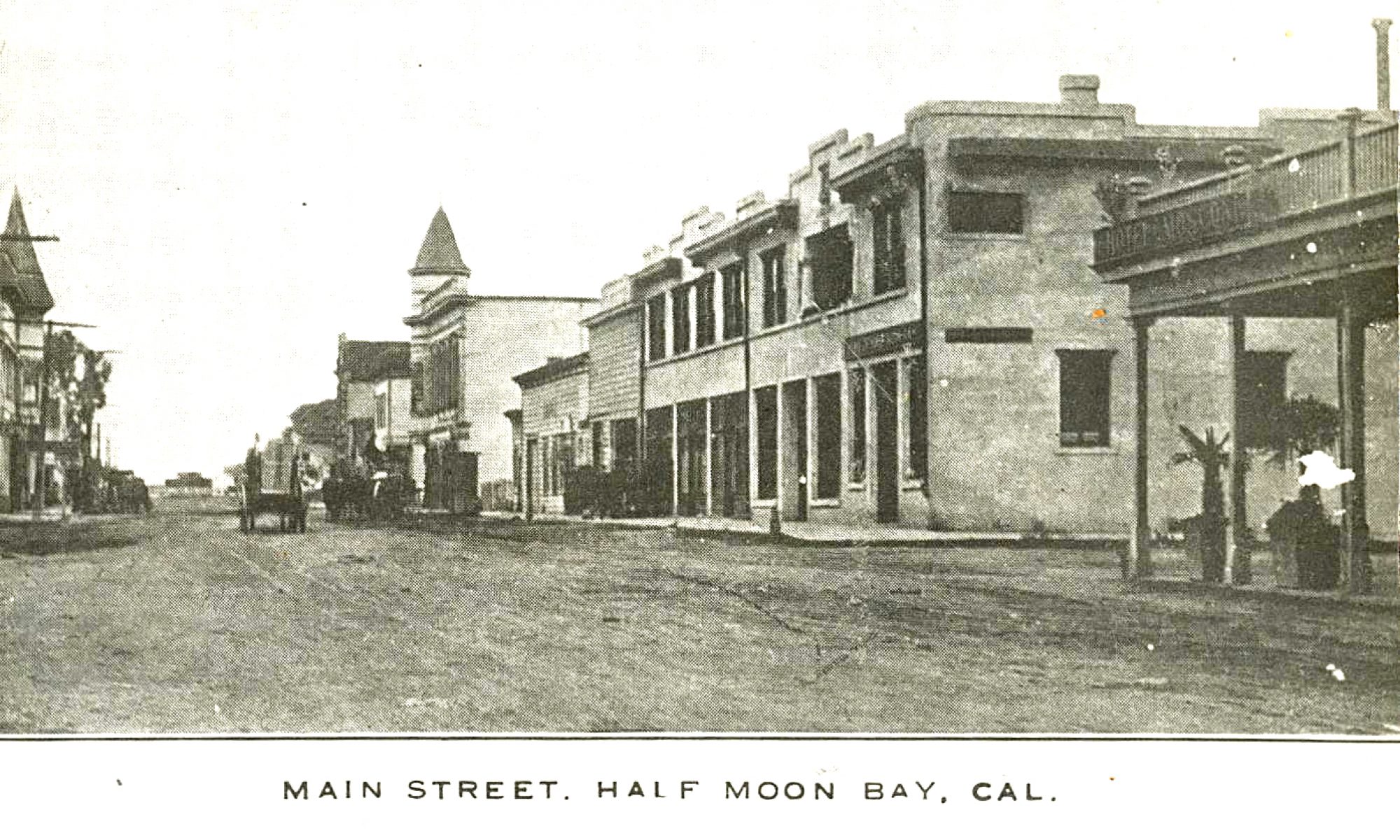
Created by June Morrall

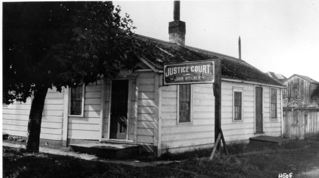 (Photo: Judge John Pitcher and his Half Moon Bay office. In the left corner (accidentally cropped out by me), it reads: “Where The Speed Cop Takes You”).
It didn’t hurt Judge John Pitcher’s image that he also held an excellent record for keeping crime out of Half Moon Bay.
When he ran for re-election in 1914, Judge Pitcher said:
“…Right here in Half Moon Bay, there is no need for law. Why our jail just fell into rust, it did. I’ve been Justice of the Peace for 35 years and never arrested more than a hobo or a speeder. I remember one man that went to state prison from here and that’s about it.”
Now came election Tuesday in 1918–and many said Pitcher’s opponent E.E. “Red” Kerrick should have listened to his friends’ advice and not challenged the old jurist–for John Pitcher easily trounced his young rival.
Pitcher continued his ironclad rule as Justice of the Peace for yet another four years. And when election time rolled around in 1922, “Old Man Pitcher”, now 94, announced again.
But time had finally run out for the old warrior and he was defeated by C.W. Borden. Once out of office, Pitcher lost some of his spark for life. He fell ill and died in 1924. All the business and schools in Half Moon Bay closed their doors in honor of Judge John Pitcher. They all knew there would never be another man like him.

In 1861 John Pitcher and wife, Louise, came to Half Moon Bay where they farmed and became well known and admired. Almost 20 years later in 1879 John was elected as Half Moon Bay’s Justice of the Peace–and for forty years nobody who ran against him could win. John kept winning election after election after election–effortlessly.
It was said that John had enough political experience to run for governor. Although he served in the tiny and remote village of Half Moon Bay, population 1,000, Pitcher built a solid statewide reputation as a jurist.
When, in 1917 California’s Gov. Stephens stopped to campaign in Pitcher’s Coastside town, he met with “the old judge of whom he had frequently heard.” Afterwards Stephens allegedly described the white-haired Pitcher “as the man who ought to be governor”.
John Pitcher was often asked for his tips on living a long, healthy life. He may be 92, he stressed, but he felt like he was 45. Age didn’t interfere with what he wanted to do.
“Keep active,” he counseled, “and there will not be time to grow old. Live simply, eat simply, sleep well.”
John advocated a life without smoking, a lemon sour after every drink and not too many alcoholic drinks at that. By 1918 he had been ill only twice in his lifetime, he confided to a reporter.
“Worry,” he emphasized, “should be avoided at all times”.
…To Be Continued…

Born in Indiana in 1827, John Pitcher came to California during the Gold Rush. He earned his informal, legal education while living and working in the shanty-town atmosphere of the Yuba mines. There was no sense of permanence here–and in this harsh environment where few women ventured– “popular justice” (think of HBO’s “Deadwood” series)–was meted out by the miners themselves.
There were no courts or judges as we know them today. Most of the time the system of “popular justice” worked, Pitcher later explained.
“Laws have loopholes,” he said. “Justice has none. Tell a man he must do right or pay the price and he’ll do right.”
But John Pitcher also learned that “popular justice” harbored a dark side. On one occasion Pitcher defended a “foreigner” accused of stealing gold which was held communally. The man was convicted although no evidence had been presented to prove that he was indeed the thief.
“A jury composted of miners,” Pitcher recalled, “sentenced the frightened man to hang. They strung him up and kept him up there encouraging the poor man to confess…Finally they cut him down and he was more dead than alive.”
The convicted man was ordered to leave at once and Pitcher said he followed his former client to the outskirts of the mining camp to make certain he was okay. Several weeks later the same men who had been the man’s jurors discovered the missing gold–and when they sent someone to search for him all “they found was his skeleton.”
…To Be Continued…
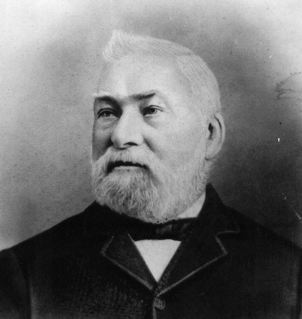 (Photo: Judge John Pitcher)
 (Photo: E.E. “Red'” Kerrick’s cafe stood on the right side of Main Street.)
“Are you crazy?” E.E. “Red” Kerrick’s friends asked him. “Nobody runs against ‘Old Man Pitcher'”.
It took heaps of optimism–great courage and fortitude–to challenge Half Moon Bay’s John Pitcher for the office of Justice of the Peace in the November 1918 election.
Not only had the sacrosanct “Old Man Pitcher” been the incumbent for an unterrupted reign of 39 years–but he possessed an unparalled youthfulness at age 92 and other extraordinary qualities that the voters found irresistable.
Despite the overwhelming odds, “Red” Kerrick, the 30-something father of seven children, threw his hat into the ring.
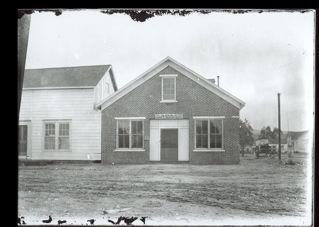
Photo: courtesy Spanishtown Historical Society, the SHS operates a small museum on Johnston St. Check with the HMB Chamber of Commerce for the schedule.
“The horses strike up a trot. You feel the ride will be too soon over, a delusion that will fade as the mountains slow the journey to two hours, or three if the road is badly out. Then the passengers must perforce dismount. And walk. Or push. Or pluck pickets from a nearby fence and pry the suddenly stubborn wheels from one deep hole into another.
“The hills part. A gate in the canyon rises on either side. Men are working, clambering, sometimes rope-supported from above. ‘That’s Herman Schussler’s gang preparing for the new concrete dam. It will make a lake of the whole Spring Valley’.
“There is a short stop at Crystal Springs House. Ax men are setting up camps to clear the trees from the lake bed to be. The road soon mounts. The horses walk.
“The hills are green-grey with varied brush. The yellow flowers, the lupines, the primrose, wormwood and mimulus dust the slopes with gold. The sun draws rich odor from aromatic plants and from the yerba buena.
“Suddenly a breath of air comes cool to your face. The scent of the sea is on it. Refreshing and exciting,. You are nearing the top of the grade.
“Now the whole world slopes westward to the sea. Far down a canyon checkered with cultivation the sun picks up the white of houses and of a tall church.
“Bob Rawles has his foot on the brake, the leather hub shuches and squeaks. The horses break into a trot. The coach rocks and rolls.
“Nearly straight below you see the roofs and the golden pumpkin patches of Albrecht.
“Beyond this the canyon opens. ‘That’s where a bear treed old man Digges. He came ahead of the wagons. They had to ground brake them down the hill. No road then. Digges sat in an alder. The bear sat on the bank. Real patient. Till the wagons come. And someone shot him.’
“The road is proving good. It is summer, the stage rolls past the adobe of the Campbells. There the boy Eddie waves, and waits for his day on the driver’s seat to come.
“The next adobe is Fred Fillmore’s. You are nearing town. Here is the Catholic cemetery. Here is Gilchrist’s creamery. Ahead is the piled bridge that spans the Pilarcitos.
“On the right, the long, low adobe of the Vasquez family. Daturas bloom against its walls, and marguerites, yellow and white, crowd the yard.
“a horseman is quietly riding out on a golden pony. Only his white beard tells you he is not a youth. He is instead a centaur. He is Pablo Vaquez. Legend had many tales of him. Did he ride with Murieta? Who knows….
….To be continued…
Photo-courtesy San Mateo County History Museum. Visit the museum at the historic Redwood City Courthouse–or better, yet, become a member!
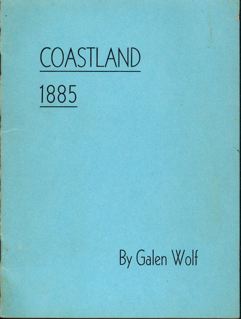
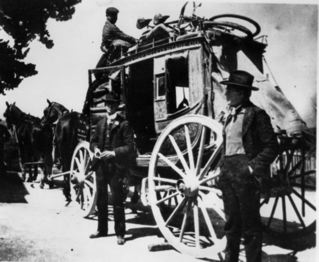

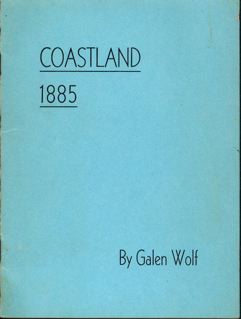
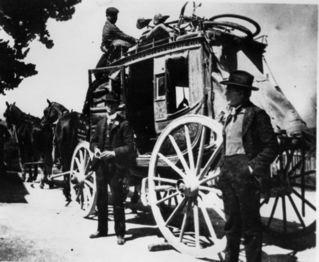
“It is June and the year is 1885.
“The train you boarded at Third and Townsend Streets, San Francisco, has been running southerly, through meadows and marshes for nearly an hour. Now it is slowing. A few houses pass the window. The brakes grind.
“The conductor flings open the door and his shout runs the length of the car: ‘San Mateo!’ You are on your way to the coastland.
“As you step down, a few surprising vehicles meet the eye. Hitched to a well-chewed pole are dog-carts, jaunting carts, tallyho and tandem. The horses are bobbed roached and the harness silver trimmed. They tell of the playland of the millionaires, D.O. Mills, Flood, Crocker, Parrot and Wm. Ralston.
“Beyond these polished but effete conveyances looms a great Concord coach, utilitarian as a merchantman in a harbor of yachts. It is the ship of the West, tremendously traditional, almost mystic. And it will carry you to the land behind the mountains.
“Its bulging body is Indian red and striped with gold. A landscape is painted on scrolled panels on either door. Leather straps support it in place of springs, and it will rock and roll like a true ship in a sea.
“Today four horses draw it. Often there are six, and it has carried the unbelievable number of twenty eight passengers. They ride in three layers, a top-heavy shortcake of seating. In the coach itself, on the roof with legs dangling, and on a seat like a hatch on top.
“Bob Rawles sits on the high perch of the driver. The passengers gather about.
“Here is Loren Coburn of the Pescadero lands, crackers and cheese in his pockets. R.I. Knapp, short and bearded, back from his plow works in San Jose. A tall man, bearded like a patriarch, swings up. You recognize James Hatch.
“The vigorous form of Chas. Borden, pipe smoking , piles in. You ask about the redwood canyon he has acquired form the Lanes and about the progress of the mill.
“A bareheaded man with pale face and ample moustache collects the fare; Ferdinand Levy. It is one dollar to Half Moon, two dollars and a half to Pescadero.
“Rawles gathers the lines, cracks his whip. The coach rolls out of town, along a single street bordering the railroad tracks. It crosses the meandering red-rock roadway of Camino Real.
“Here stands a sign post. Some joker has shot a piece from it. Truncated, it read, “Moonbay and scadero”. Beyond, the green-grey hills rise.
…to be continued…
Photo: courtesy San Mateo County History Museum. Visit the museum at the historic Redwood City Courthouse in Redwood City.
The Romance of Half Moon Bay (cont’d)
Half Moon Bay is the historic land of Father Serra and the Missions, of Wells Fargo Stage runs along the dusty roads, of old adobe homes, of the Indians, of the pioneering immigrants from across the sea.
Of special historical interest is the James Johnston House, the first example of New England Salt box architecture brought to the West Coast. The structure still stands and restoration of the home is planned in the near future by the Johnston House Committee (ed. now completed). Upon completion, the Johnston House will be open to the public–a reminder of the elegant past of this charming coastal hamlet.
But it was more than beauty and history that kept people coming to Half Moon Bay. The old rutted San Francisco wagon trail of 1854 became a modern highway. The three-day journey became a thirty-minute drive. Soon there were roads in all directions. The sun and the sea and the good,clean air drew residents in greater and greater numbers, many commuting to San Francisco and Peninsula cities.
Some important points of interest, accessibleby car, are indicated on the map below–click to enlarge


