Devil’s Slide

For your enjoyment, I have placed all my Devil’s Slide stories and photos here.

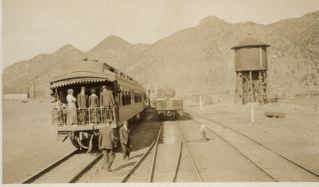
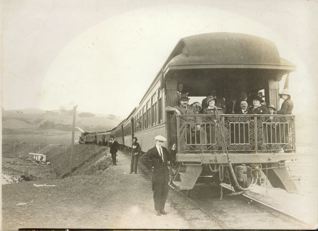
A Short History Of The Ocean Shore Railroad (Part I)

train.jpgA Short History Of The Ocean Shore Railroad (Part I)

As told to me in 1980 by Randolph Brandt, whose father was an investor, a stockholder, in the Ocean Shore Railroad:

“He, like a number of other people in the days when the stock was being offered to the public market, thought it was a good thing and it apparently was.

“There are a number of banks and prominent people—quite a number of people, well-heeled financially that invested money in it. Mr. Downey Harveyt there, was one of the original promoters of the line and he dropped, I think, around $2 million in it. Of course, he was one of those people that inherited the money, you know, didn’t have to work for it.

“And another man who was pretty well-off financially, too, was Mr. Foelder of the well known Foelger Coffee Company, and he dropped quite a bit of money into it—somewhere between a million and a million-and-a-half.

“In those days, a million was not considered pennies.

“When they got this thing started—it was just before the earthquake, well, 1905, well, railroads were springing up all over the place, up and down the state—from one end to the other they were starting to build…

“Why not a line down the coast to Santa Cruz?

“One of the reasons was tht they figured if they built the line through to Santa Cru they could take a lot of the business away from the SP [Southern Pacific], which had the monopoly up ‘til then by going the other way.

“Look like a good proposition. No one else was in there. They started work from both ends with one crew working from San Francisco south, another crew starting from Santa Cru, working north.

“Got along fine until a certain day in April 1906 when they had an earthquake. One of things they didn’t’ anticipate was a good deal of construction equipment, particularly in the area around Mussel Rock tumbled off the right-of-way and down into the ocean.

“A considerable financial loss.

“And part of the right-of-way, likewise, followed the equipment into the ocean—more financial loss—and additional expenditures the promoters hadn’t figured on.

“Recovered from that somehow and they pared down the project a bit as a result of that. One of the shortcomings of the original promoters was that they were a little too grandiose in their ideas. They started out—it was planned as a double-track electric, actually, to run from San Francisco to Santa Cruz, via Half Moon Bay.

“Better off if they’d started out with a single-track steam line. Then as business justified it, then extending to double-track, they might have succeeded. When you grade for a double-track along the line it actually costs you more than if you grade for a single track, so it means more money out. Since they never used the double track, well, it was just money wasted…”

Photo: Randolph Brandt

…To be continued…

Coastside Has History Of Shuttle Buses

shuttle1.jpg

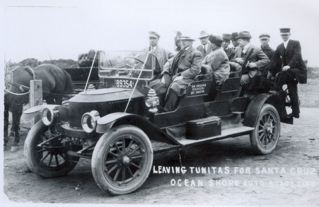
The Coastside has a history of shuttle “buses”. This one shuttled passengers from San Gregorio, Pescadero and Swanton to Santa Cruz and back. Note the conductor sitting on his perch.

I wonder if our new shuttle be as colorful.

Photo: Randolph Brandt

1913: Pedro Mtn Rd Called For Coolest Heads, Firmest Hands & Strongest Brakes

In 1913 a “See America First� travel campaign captured the imagination of new car owners, and hot on the trail of the trend, the California-based editors of “Motoring� magazine recommended that readers “see Half Moon Bay first�.

What they called the “Kings Mountain to Half Moon Bay� tour caught on quickly. “Motoring� advised “camera fiends� to brings rolls of film to capture “the picture primeval and beautiful, as it is restless and wild.�

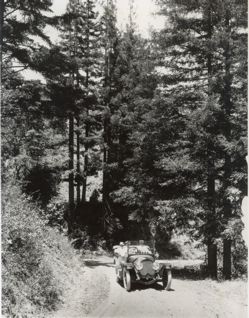
Clutching the steering wheel of the latest model Kissel Kar, the driver and his party of motor enthusiasts sampled the much talked about 1-day tour from Kings Mountain to Half Moon Bay.

For the jaunty motorists in the Kissel Kar, the Kings Mountain “road� resembled not a rocky brown trail but rather verses from an 18th century poem: “a long green lane canopied overhead with interlacing boughs.�

kissel1.jpg

Traveling west over Tunitas Creek Road, they paused to contemplate an abandoned sawmill, overgrown with ferns. The Kissel Kar passed through the shadow-filled canyons bordered with vibrant green ferns and Redwood trees. The canyons opened up as the Pacific Ocean and the rolling hills came into view. The air felt cooler and the color of the landscape changed from green to earthy brown tones.

kissel2.jpg

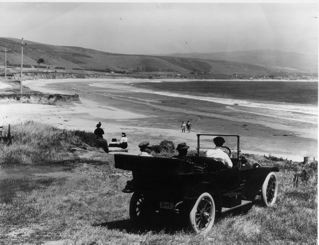
The new Kissel Kar swung north toward Half Moon Bay—then better known as “Spanishtown�. The town’s mood was sleepy, compared with the wheeling and dealing that had dominated the area during the Ocean Shore Railroad real estate boom.

kissel3.jpg

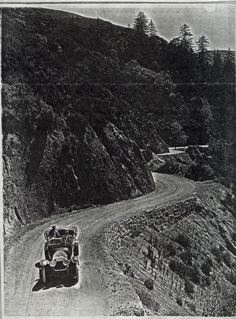
But when the automobile continued heading north to enjoy the spectacular views from Pedro Mountain Road near Montara—the editors of “Motoring� magazine discouraged readers from following in their tire tracks.

“Even with a thoroughly reliable driver and trustworthy car,� advised the magazine, “Pedro Mountain road is in such poor condition that anyone going this way is simply inviting disaster.�

pedro13.jpg

Underscoring the danger was a large sign that read: “DANGEROUS FOR AUTOMOBILES—TAKE ROAD VIA SAN MATEO�

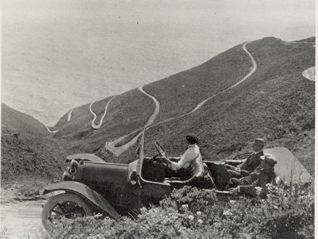
If they chose to ignore this sign, motorists encountered grades as steep as 25 percent in some places. The hairpin turns called for “the coolest heads, firmest hands and strongest brakes that a car can have.�

But while the driver and his passengers in the Kissel Kar warned others not to drive Pedro Mountain Road, they took the risks—and as a result, we can enjoy the photographs they took more than 90 years ago.

Montara Bob Responds To The Shuttle Futtle: “Mad As Hell, Not Gonna Take It Anymore” Devil’s Slide Email

Hello June,

Thanks for running the SF Examiner piece on the shuttle bus.

I used to read the Examiner regularly but these days the only place I can get reliable information about Devil’s Slide is online, mostly from you.

Maybe I’m a bit dim but I don’t understand what this shuttle is supposed to do.

Does it run just north and south, on highway 1? I thought we already had buses that do that (the ones I see are always empty).

One thing’s for sure. May the Good Lord protect us from any organization that’s called the Peninsula Traffic Congestion Relief Alliance. It’s bound to cause more trouble than any good.

And who, in heaven’s name, ever heard of the Parking Company of America? Just what we needed– another entity sucking up taxpayer money.

Well, I hope these shuttles are well marked so at least we’ll know who these folks are that are making traffic even worse.

Why didn’t they just take the $160,000 and apply it to fixing the Slide? Maybe that would help get Devil’s Slide open an hour sooner.

Montara Bob

Devil’s Slide: “Mad As Hell, Not Gonna Take It Anymore” Email

So the politicians have a “solution” to the Devil’s Slide Crisis:
an expensive government shuttle, with the dough going to
the Parking Company of America (how appropriate).

It will enable Coastsiders to sit in a dirty
bus for hours, and then drop you off in inconvenient locations
on the Coastside and elsewhere, so you can take more
socialist buses.Talk about time-wasting, money-wasting baloney.
Let’s put the bureaucrats and politicians on the bus permanently,
and Open Devil’s Slide, Now.

Lew From Far Away

Devil’s Slide: I Guess This Will Solve All Our Problems! Are They Kidding?

I don’t understand this story: tell me more about the shuttle. Is it crossing Devil’s Slide? Will we be able to see what construction crews are doing? Can we keep our cars on the Pacifica side and get a free ride over the Slide to Half Moon Bay? What will the shuttle look like? Air conditioned for those hot summer days? Who are the drivers? Will you be hiring local drivers?

shuttle.jpg

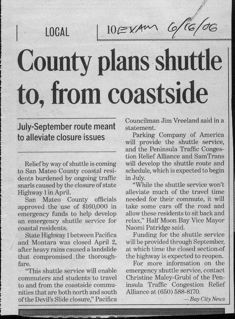
(From S.F. Examiner, June 16, 2006)

“County plans shuttle to, from coastside
July-September route meant to alleviate closure issues

Relief by way of shuttle is coming to San Mateo County coastal residents burdened by ongoing traffic snarls caused by the closure of state Highway 1 in April.

San Mateo County officials approved the use of $160,000 in emergency funds to help develop an emergency shuttle service for coastal residents.

State Highway 1 between Pacifica and Montara was closed April 2, after heavy rains caused a landslide that compromised the thoroughfare.

‘This shuttle service will enable commuters and students to travel to and from the coastside comunities that are both north and south of the Devil’s Slide closure,’ Pacifica Councilman Jim Vreeland said in a statement.

Parking Company of America will provide the shuttle service, and the Peninsula Traffic Congestion Relief Alliance and SamTrans will develop the shuttle route and schedule, whic is expected to begin in July.

‘While the shuttle service won’t alleviate much of the travel time needed for their commute, it will take some cars off the road and allow these residents to sit back and relax,’ Half Moon Bay Vice Mayor Naomi Patridge said.

Funding for the shuttle service will be provided through September, at which time the closed section of the highway is expected to open.

For more information on the emergency shuttle service, contact Christine Maley-Grubi of the Peninsula Traffic Congestion Relief Alliance at (650) 588-8170.”

Devil’s Slide As Seen By Artist Galen Wolf

WolfA.jpg

Wolf2.jpg

Mullenhse.jpg

When I photographed these two Devil’s Slide watercolors by Coastside artist Galen Wolf, they were hanging on the walls of the historic Mullen farmhouse in Miramar. The Mullen’s accountant, Tom Clyne, had inherited the home and was living there in the 1970s.

Nancy Maule: Notable Coastside Environmentalist

Nancy1.jpg

Nancy2.jpg

Nancy3.jpg

In 1980-81 I interviewed Montara environmentalist Nancy Maule at her Montara home for “The Mystery of Half Moon Bayâ€?. I don’t know what I expected but she looked like a stern schoolteacher. As soon as she began talking it was obvious that she was not only passionate about her beliefs but she knew the history of environmentalism on the Coastside.

A proposed freeway helped fuel Nancy’s activism (she didn’t drive a car when I met her). She recalled hosting a meeting in her living room organized to fight the freeway, with the preservation of open space the objective.

Nancy’s group considered the possibilities of a federal reserve stretching from Milagra Ridge to the north all the way south to Highway 92, encompassing some 40,000 acres.

“When we first arrived in the 1950s,� she told me, “there were no development plans. It was quiet until the early ‘60s. Then we heard [Henry] Doelger had huge plans to develop.�

[Doelger was eyeing Princeton-by-the-Sea for what he envisioned as a “Polynesian Village�, with all the “tropical� trappings you can imagine].

There’s a local legend, Nancy said. “Doelger brought the president of the Bank of America to one of the hilltops, waved his hand, and said: ‘Eureka! We’ve found it! Here’s my new city’. The Bank of America president thought it was a great idea.

“….The only plans effectively carried out can be seen in Half Moon Bay—which delineates the philosophical attitude between Half Moon Bay and the rest of the Coastside,� Nancy said, adding that “All growth comes to pass in Half Moon Bay.�

Note: Nancy Maule’s group of activists successfully picketed Henry Doelger’s project at Princeton. The big developer’s plans for a “Polynesian Fishing Village” fell through but he did construct a housing subdivision across the way, on the east side of Highway 1.

Montara: Home to Artist’s Colony & The Little Goat Farm (Part III)

cutehouse_2.jpgAt the foot of Montara Mountain, an artist’s colony, the dream of San Francisco publisher Harr Wagner and his poet wife Madge Morris, seemed to be unfolding in the most beautiful way.

A few quaint cottages were built and artists moved in with their musical instruments, pens and watercolors. The nearby streets were named in honor of authors Bret Harte, Elbert Hubbard and Rudyard Kipling. A bakery opened its doors and many in Montara viewed the new community as economically self-sustaining.

Harr constructed a family residence featuring stone pillars and a circular driveway. To establish a sense of tradition at Montara-by-the-Sea, he organized annual barbecues, attended by his artist friends.

Mussels were harvested from the nearby beaches and placed in steaming kettles while steaks sizzled on the open grills. Harr presided over the festivities, always the jovial host attired in chef’s hat and white apron.

Perhaps in anticipation of the flood of tourists attracted to the 1915 Panama-Pacific International Exposition in San Francisco, Harr helped construct a lovely resort hotel framed by the warmth of Montara Mountain.

montarainn.jpgmontarainn1.jpg

But Harr’s reputation for taking risks that generally failed was not about to change. The artist community at Montara was no exception.

The Ocean Shore Railroad—the artery that carried life to Montara and other Coastside beach towns—filed for bankruptcy and pulled up its rails. A fire swept away the resort hotel and a future conflagration would take the Wagner’s family residence, leaving only the stone pillars.

The Wagner family, which included daughter Morris, weathered the latest financial setback in typical fashion. Harr shrugged his shoulders and humorously labeled himself a “successful failure�.

But despite Montara’s economic reverses, the tiny beach town still retained its identity and lure for artists. Real estate sales may have tumbled but the “Von Suppe Poet and Peasant Cottage�, honoring a 19th century European composer, was still in demand at a rental fee of $85.00 weekly.

Meanwhile, daughter Morris was thriving. She had been named the postmistress of Montara, and with an initial investment of $350.00 , began raising those milk goats with good friend Irmagarde Richards.

Within a few years, Morris and Irmagarde’s work won acclaim as observers praised them for “controlling the goat industry in this part of the world�.

Their goats were not what Irmagarde labeled the “back alley� sort. She and Morris aimed much higher, raising gold medal winning, blue-blooded Toggenberg goats, the breed that were used in experimental gland transplantation in the elderly.

According to Irmagarde, their goats were attractive and highly efficient milk producers. A steady stream of physicians had made the trek to Montara for goat glands but the women were not interested in that phase of the business.

Their goats provided sweet milk only—no parts.

In 1922 goat milk was a valuable commodity because it wasn’t produced in large quantities by commercial dairies. This situation enabled Morris and Irmagarde to sign a contract with a tuberculosis hospital in San Mateo to provide 60 quarts of goat’s milk per day. The milk from their herd of 200 goats was earmarked for children with TB who were unable to digest other foods.

Tuberculosis, which most commonly affects the respiratory system, is usually acquired from contact with an infected person, an infected cow, or through drinking contaminated milk.

“Today, after nine years of hard work and fun,� Irmagarde Ricahrds said in 1922, “we have one of the best-equipped milk goat establishments in the world.�

But there years later, in 1925, the world of “the goat girls� was turned upside down. After a long illness, Morris’s mother died at Montara—and technology introduced new baby food formulas into the marketplace.

The demand for goat’s milk dwindled and the Las Cabritas (Little Goats) Farm at Montara quietly ceased production and closed its doors.

Note: I actually met Morris Wagner. She was elderly and lived in a very nice senior home in Los Gatos but what impressed me most was her face, filled with light and warmth and great love, her father’s daughter, I felt certain.

Photos: Quaint house in Montara & Montara landscape with Montara Inn perched on the hillside.

Montara: Home to Artist’s Colony & The Little Goat Farm (Part II)

scenic.jpg (Photo: Scenic Montara, with Devil’s Slide in the background).

Montara was the first in a string of charming beach towns encountered by Ocean Shore Railroad passengers as they left behind the breathtaking vistas of the spectacular ride across Devil’s Slide, the vastness of the Pacific Ocean and the striking patterns of the fragile cliffs.

From the quaint Montara train station, fields stretched in all directions, with footpaths leading to a graceful 19th century lighthouse, a church with a small spire and virgin beaches thick with white sand.

The visual effect made some visitors imagine they stood on the stern of a ship far out in a foggy sea—but the gracious dominance of Montara Mountain in the background, hosting sprays of brilliant wildflowers, reminded everyone they remained on land.

Montara was the home of Vic Guerrero, heir to an original Spanish/Mexican land grant. In Guerrero’s less complicated Montara, the most famous resident was William Haavind, “Billy the Kid,� a colorful foot racer known for his daily sprint up to Devil’s Slide and back.

This, then, was Montara in the early part of the 20th century, the place Morris Wagner came to know and love.

Anyone acquainted with Morris soon learned that her father, Harr, had purchased one square mile of beautiful Montara, believing the property would rise in value along with the fortunes of the Ocean Shore Railroad.

He may have originally hoped to sell small lots to all comers but he quickly refined his plan, announcing that Montara would become the center of an artists’ community with a college as its beating heart.

The arts and crafts community made sense to all who knew Harr and Madge. They had countless artist friends including the famous, long-haired bohemian poet, Joaquin Miller. To assist Harr in promoting Montara, Miller rode the Ocean Shore Railroad to the Coastside town where he planted a special redwood tree to the delight of spectators—including the press.

While Morris’s mother penned books of poetry, her father named the streets of Montara in honor of the authors Bret Harte, Elbert Hubbard and Rudyard Kipling. A few tidy cottages were built and artists moved in with their musical instruments, pens and watercolors.

A bakery was opened and many began to view the community of Montara as economically self-sustaining.

manmontara.jpg

(Photo: Montara artist & his dog outside their Montara cottage.)

….To be continued…

Looking Towards Stunning Devil’s Slide

ds.jpgphoto by Jerry Koontz (30 years ago)

Montara: Artist’s Colony Home To The Little Goat Farm (Part I)

While many Coastsiders were involved in the business of illicit alcohol during prohibition, Miss Morris Wagner pursued a more temperate activity.She raised milk goats at “Las Cabritas�, (little goats), her ranch in Montara.

goats.jpg (Photo: Morris Wagner & Irmagarde Richards with their goats at Montara).

Cases of childhood tuberculosis were on the rise—and goat’s milk was prescribed as a safe alternative to cow’s milk, which purportedly carried the germs of the contagious respiratory disease.

Combining the promise of monetary reward with a noble mission, Morris Wagner set out to provide the nourishing goat’s milk needed by the sick kids in San Mateo County where herds of grazing cows were still a common sight on the rolling green hillsides.

To outsiders unfamiliar with Morris Wagner’s background, raising goats might have seemed an unusual career choice for the athletic young woman.

Her father, Harr Wagner, a prominent educator and literary publisher, had risked his savings in real estate misadventures in California and rubber tree plantations in Mexico that failed miserably. Only the literary magazines he published paid the bills.

Morris’s mother, Madge, was a frustrated poet who fervently supported women’s suffrage and did not take her husband’s name upon their marriage in the 1880s.

Friends might have predicted a safe teaching career for Morris Wagner but she exhibited the rare qualities of both parents. While her milk goat business was not too secure financially, there were intangible rewards, the good feelings one gets from doing humanitarian work.

If Morris was puzzled by something about farm animals, she could draw on her father’s deep well of knowledge. He had grown up around barns and stables in Pennsylvania.

Whatever deficiencies Morris had in the field of animal husbandry, she solved by pooling talents with Irmagarde Richards, a close friend who also happened to be a goat expert.

Surely Irmagarde Richards was the inspiration if not the guiding spirit at “Las Cabritas�. In the 1920s, Irmagarde became the president of the California Goat Breeders Association—and she had authored a well-received book about modern milk goats. She was a Stanford grad who had taught Greek and archaeology at the prestigious Mills College in Oakland, the first women’s college established west of the Rockies.

It was in the classrooms and on the grounds of historic Mills College that the student Morris Wagner struck up a lifetime friendship with teacher Irmagarde Richards.

At the time the two women met, Morris had lived in different parts of California but her most recent address was a post office box in Montara.

rr.jpg

photo San Mateo County History Museum. Visit the museum located in the historic courthouse, Redwood City.

…To be continued…

Thank You Local Radio

Thank you local San Francisco-Bay Area radio–especially the “traffic & weather” together station…for reporting on accidents and other Half Moon Bay-Coastside road problems.

You seem to be more aware of our daily agony with Devil’s Slide closed.

Yesterday I was traveling home from Marin County when I learned that the traffic light was out on Highway 1 near where I live. Sure enough, there was a Caltrans repair crew on site fixing the problem.

Today during the evening commute, I was advised of an accident ahead of me on Highway 92.

Keeping us posted makes it a bit more bearable.

« Previous entries · Next entries »