Archive for November, 2007

Tom Wolfe’s “Electric Kool-Aid Acid Test” May Go To The Big Screen

John Vonderlin sent me this info about Tom Wolfe’s “Electric Kool-Aid Acid Test” moving from words in a book to images on the screen. Former La Honda author Ken Kesey & the Merry Pranksters are the main characters in Wolfe’s book.

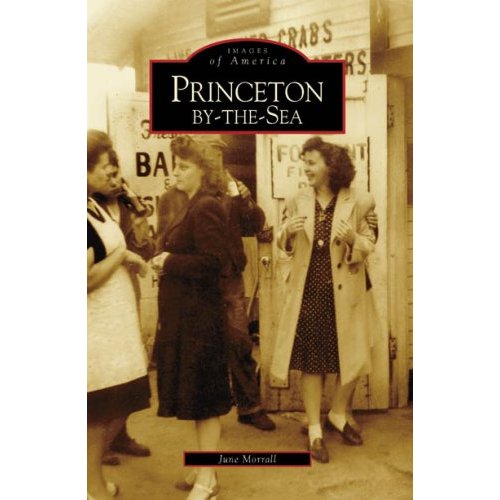
What it made me think about was this: In the late 1950s some unusual and talented Beatniks were run out of their homes around the cafes in San Francisco’s North Beach and headed south where they found a temporary haven at our Princeton, north of Half Moon Bay. There’s a chapter on this in my new book, “Princeton-by-the-Sea,” due to be published by Arcadia on Dec. 10.
511jj6-j5al_ss500_.jpg

The story of the Beatniks, including the famous artist Michael Bowen, who lived at the Abalone Factory in Princeton, is a little known and juicy slice of local history– and I am very proud to have resurrected it, prompted by long ago interviews with Pete Douglas of the Bach Dancing & Dynamite Society in Miramar. (Pete’s also in my new book.)

What’s interesting is that these Beats who were in-your-face types, that were harassed by the cops and others, and protested on the spot–also overlapped the period that Ken Kesey was driving his day-glo painted school bus through the redwoods of La Honda.

But guess what? They didn’t get along, the Beats & Kesey. Not only a little generation gap but here’s my ice cream analogy: If the Beats were double chocolate fudge, Ken Kesey & the Merry Pranksters were definitely vanilla.

I hope Movie Director Gus Van Sant explores that in his new movie.
Comments off

The Ones That Got Away By John Vonderlin

Hi June,

As I mentioned in an earlier email, a large portion of the non-buoyant marine debris I collect from Neptune’s Vomitorium, comes from the various fishing industries that ply our local coastal waters. In this portion are the majority of items that pose the greatest dangers to various lifeforms that inhabit the coastal areas as well as unwary beachwalkers.

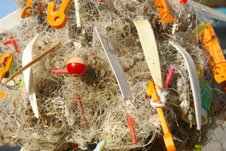
But, because of their great number and astounding variety I’m happy that they have provided me with the raw materials for a sizable number of pieces of artplay. I’ve attached a few pictures of pieces from my series entitled: “Neptune’s Burden: The Ones That Got Away.”

The first two photos are of the original “Neptune’s Burden.”

nb.jpegnb2.jpeg

It’s a work in progress, as I have a large number of small bits of lost fishing gear (hooks, swivels, leaders, etc.) to cut out of the three trash cans full of fishing line balls that I still must process and add to the World’s Largest Fishing Line Ball.

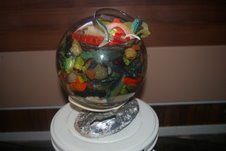
The third photo is a naturally-polished abalone shellabshell.jpeg

topped by a part of a plastic buoy in which the glass sphere full of colorful rubber fish lure remnants rests.

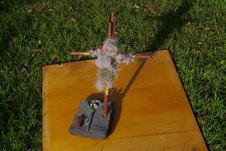
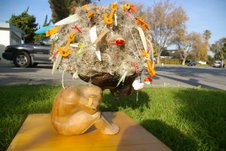
The last photo last.jpeg        is of a fishing pole’s broken remnants entangled with other balls of line and a piece of cloth. I had to do almost nothing to this.

In fact, my beachcombing partner assumed it was a fisherfolk’s homemade grave marker that had washed away when she first saw it. It isn’t, but its appearance and the proportions of its remnants dictated its use in my mind. If you look closely you can see the eyelets that guide the line on a fishing pole entangled in the mess. The mourners are composed of a pareidolic rock and marine debris pieces. Enjoy. John Vonderlin

Email John: benloudman@sbcglobal.net

Comments off

What Happened to the El Granada Garden Club?


flowers.jpg

When I first moved to El Granada, I couldn’t help but notice that some of the median strips–especially the one near El Granada Market–were filled with flowers. A sign told me that the flowers had been planted and were maintained by the El Granada Garden Club.

Garden Club members planted colorful flowers and also pine trees–Daniel Burnham style– (if you don’t know who Mr. Burnham was–he was the renowned architect who, during the Ocean Shore Railroad era, developed the unique street plan for El Granada, you know, the one you can get lost in– and, who, intended that there be vast plots of flowers and trees planted along the broad avenues.)

In the early 1900s, flowers and trees were planted as Burnham indicated in his beautiful plan. But after the Ocean Shore went bust so did Coastside real estate, and, well, there was nobody around to do the gardening.

Being a great lover of flowers and gardens, I can’t help but wonder who was going to water all those plants and trees? Who would pay for the watering? What would happen if there was a drought? Had the Ocean Shore thought it through?

Most of all, I am wondering what happened to the El Granada Garden Club….

Comments off

1980: In A Nutshell: Coastside Architectural Styles

From “Coastside Cultural Resources of San Mateo County”

Montara..Moss Beach…El Granada…Princeton-by-the-Sea…Miramar

“These communities were established on the Mid-Coast between 1906 and 1909 during the real estate boom that followed the construction of the Ocean Shore Railroad. Speculators quickly subdivided the lands along the new rail line, expecting a real estate boom to follow in its tracks. This never took place. Few of the subdivided lots were developed during the first half of this century.

“By 1950, the Mid-Coast population was only 1,700 residents. During the next two decades, however, the population more than doubled to 4,000.

“As buildable land on the Bayside disappeared, many contractors discovered the abundance of vacant subdivided lots in the community. A small building boom resulted and by 1979 over 6,500 persons resided in the area.

Read the rest of this entry »

Comments off

Artist Molly Ramolla & How To Make “Almost-Papyrus”

molly.jpeg

(Photo: Molly Ramolla)

For story, click here

(when you get there, scroll down…)

Comments off

1960s: “Water is major Coastside problem if there is influx of people”

To read story, click here

Comments off

Our Beaches: The Good….Bad…Ugly….by John Vonderlin

To read John’s story, click here

megs-cd1124-900.jpg

(Photo of the “Good,” courtesy John Vonderlin.)

Email John: benloudman@sbcglobal.net

Comments off

What I’m Reading….Uh-Uh

If you thought the justices at the Supreme Court were brilliant…thoughtful….wise…

Uh-Uh

They’re just like everybody else, only much worse.

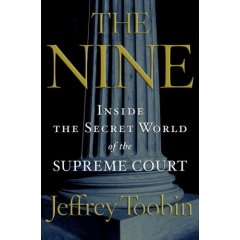
5190bikiypl_aa240_.jpg

“The Nine: Inside the Secret World of the Supreme Court” by Jeffrey Toobin. Author Toobin is a legal analyst for the “New Yorker” magazine.

Prepared to be enlightened…..and……depressed– sorry to say.

Please try to buy some stuff local: May I suggest Bay Book, Coastside Books or Moon News Bookstore, all in Half Moon Bay. There’s also a used book store on Main Street.

Comments off

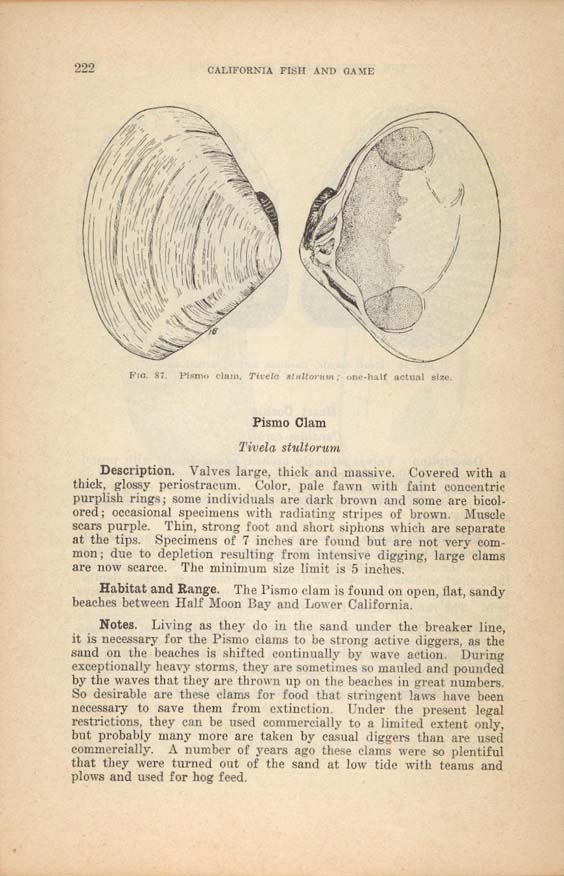
1940: Meet the Halfmoon Bay Bivalves

To read story, click here

pismoclam10.jpg

Comments off

MontaraMaryMontaraMaryMontaraMaryMontaraMaryMontaraMary???

Comments off

Herd of Giraffes Sighted on Main Street

It wasn’t exactly a “Black Friday” but it was a bustling Saturday after Thanksgiving on Main Street in Half Moon Bay. The African gallery called Sujaro– where a herd of giraffes (each one unique, carved out of a whole piece of mahogany– in Kenya)– caught my eye. Manager Ethan Rider told me that customers usually buy only one of these gorgeous wooden creatures–but I could see a dozen of them gracing a big room.

photo2.jpg

(Photo: Sujaro Manager Ethan Rider poses with the giraffes.)

Sujaro: 424 Main St., Half Moon Bay. Across the street from the famous San Benito House.

Comments off

Princeton’s Fran “Buzz” Young Checks in…the “Tall ships” are here..

For story, click here

To enlarge photos, click on images

thanksgiving-055.jpg

thanksgiving-037.jpg

thanksgiving-10.jpg

Comments off

Mikie Benedict’s Montara: Never Cold at “Johann Sebastian” Scranton’s Cold Comfort Farm…

Story by Mikie Benedict

richard10.jpg

(Photo: Richard Scranton, courtesy Mikie Benedict)

Richard Scranton, known to some of his music-making acquaintances as Johann Sebastian Scranton, lived in a little green house in Montara with a sign over the door: “Cold Comfort Farm�.

Richard’s ultimate desire was to hand-copy and arrange all 371 of Johann Sebastian Bach’s harmonized chorales so that they could be played on the keyboard. Before Richard died at the age of 75 in 2004, he managed to complete this enormous effort. He called his handwritten manuscript the Ill-Tempered Clavier, a takeoff on Bach’s encyclopedic work, The Well-Tempered Clavier.

richards-chorale.jpg

(Image: Richard’s Chorale, courtesy Mikie Benedict)

In the front room of Richard’s house on George Street was an instrument which resembled an 18th-century harpsichord, but which on closer inspection proved to be two modern keyboard synthesizers set into a
harpsichord case so cleverly covered with wood-grain paper that it truly fooled the eye.

Richard made digital recordings of his self-taught keyboard playing on this wonderful machine, sometimes painstakingly inputting the chorales note by note and editing out his mistakes.

The floor of “Cold Comfort Farm” was carpeted wall- to- wall with shag scraps cut and glued in a checkerboard pattern, and the walls were densely hung with Richard’s own skillfully-painted facsimiles of European and Asian masterpieces. He made his own curtains and upholstered his own furniture. It was not cold in Richard’s house: Through an innovation best left unexamined, he kept the temperature at about 78 degrees year round.

“Cold Comfort Farm�, an expression from Shakespeare, was the title of a comic novel by Stella Gibbons published in 1932. The book, set in the fictitious village of Howling, Sussex, was made into a film by the BBC in 1995.

Richard Scranton’s past was mysterious. He had a mother somewhere, but had no contact with her. He had a cat, but she died. At some point he had been a barber and trusted no one else to cut his hair, which finally he shaved off. He had traveled to Europe. He had a library-class record collection and knew everything worth knowing about all kinds of music. He had been a custodian at a local school for a while.

Although he was gentlemanly and courteous to his neighbors, he preferred to be alone most of the time. He cooked for himself in an electric skillet. He
sometimes rode a motorcycle or a bicycle, but did not drive a car.

In late summer of 2004, his neighbors and a handful of acquaintances held a musical memorial service for Richard at Cold Comfort Farm. The building is now used as a studio by the owners, who live next door.

———————————-

Mikie Benedict’s beloved daughter, Anna vanished from her Purisima Creek home in 1974. Please visit Mikie Benedict’s (searchingforanna.com website)– click here

Comments off