Archive for October, 2006

Almost November On The Coastside

Comments off

A Confusing Paper Trail: Part IV Conclusion

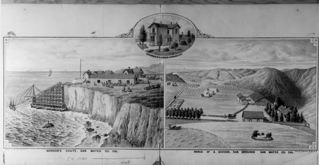
AGordon.jpg(Photo: County Supervisor Alexander Gordon became one of the defendants in the San Gregorio Rancho case. This 1870s illustration was made on site, showing “Gordon’s Chute” at Tunitas Creek, the countryside and Gordon’s home]

The most notorious legal contest was yet to come as the “famous San Gregorio Rancho case” was brought before the San Francisco Superior Court in 1872. Who were the legal owners?

The “San Gregorio Rancho case” dragged on for a decade and affected prominent men–among them County Supervisor Alexander Gordon who built the fantastic, but ill-fated, “Gordon’s [shipping] chute” at Tunitas Chute.

Judge Hunt unraveled the convoluted events and found that Antonino Buelna left a will granting two minor heirs a fifth interest in the Rancho San Gregorio. These heirs sold their interest to Hugh Hamilton–who then resold it. Later, ignoring the sale to Hamilton, the heirs sold their interest again!

The whole thing was finally settled in favor of the defendants, including Alexander Gordon.

Attached to the original, yellowed document that relates the story I just told you–is label that reads: “1247 San Gregorio R. formerly Santa Cruz County now in San Mateo Co.” Perhaps this document was entered as evidence in the famous San Gregorio Rancho case.

Possibly it was simply a detailed records of land transactions of the Rancho San Gregorio. The document covers critical years in California and Coastside history. California became a state and the rancheros were driven out…..

Photo: San Mateo County History Museum. Please visit the museum’s new exhibits at the historic Redwood City Courthouse in Redwood City.

Comments off

A Confusing Paper Trail: Part III

SG10.jpg

Francisco Casanueva, the Chilean businessman, divided the rancho into parcels sold to Americans including James Bell, Henry Wilkins nd Hugh Hamilton.

Hamilton is credited as an early American settler. He lived in a large frame house that once stood on the north bank of San Gregorio creek. An 1860 official survey map shows a fence belonging to him. It is also said tht when he arrived in San Gregorio he “saw tht the land was mixed-up,” perhaps implying that he knew title to property there was not clear.

James Bell– whose descendants went into the hotel business in San Gregorio–was a highly respected pioneer who had a post office called Bellvale named in his honor.

In the early 1860s Concepcion received her patent from the Land Commission in San Francisco–but it was too late as the land had changed into the hands of the Americans.

…To Be Continued….

Comments off

A Confusing Paper Trail: Part II

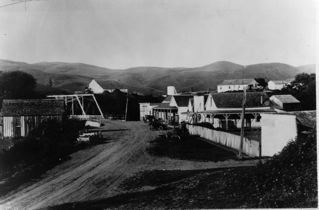
SG22.jpg

In 1839, California Governor Alvarado granted four- square leagues of the Rancho San Gregorio to Antonino Buelna—who was busy “fighting Indians and foreigners in the San Joaquin.�

Life seemed uncomplicated and no one bothered with the details of an official land survey. The Rancho San Gregorio was simply described as being bordered “on the west by the Arroyo de los Lobitos, on the north by the Sierra Grande, on the east by the land owned or claimed by Fran Gonzales and on the south by the Pacific Ocean.�

Seven years later in 1846– after Mexico went to war with the United States—Antonino Buelna died, leaving a widow and a daughter…but according to the document, Buelna’s last will did not clearly specify how the estate was to be dispersed. That could have delayed legal transfer of the property but it did not stop hasty and questionable land transactions.

Buelna’s relatives sold pieces of the valuable property—their names appear on the document.

In the interim, Antonino’s widow, Concepcion, married Francisco Rodriquez. In 1851, Rodriquez failed to pay $118.12, the amount of state and county taxes due on the rancho. As a result of non-payment, the rancho went up for sale at a public auction. Strangely, the highest bidders—William Baker of Massachusetts and his attorney J. L. Majors—picked up the rancho for a scant $118.12, the exact amount of taxes due.

Baker and Majors turned around and sold the land to Chilean businessman Francisco Casanueva for $10,000.

The yellowing document revealed yet another transaction, this time between Buelna’s widow, Concepcion, and the Chilean businessman.

Confused? So am I.

Concepcion also applied for a patent on the rancho from the U.S. Land Commission Secretary in San Francisco.

Is it possible that the same land was sold twice? As to whatever actually happened and who paid whom, and for what reasons, the document paints a confusing picture.

…To be Continued…

Comments off

A Confusing Paper Trail: Part I

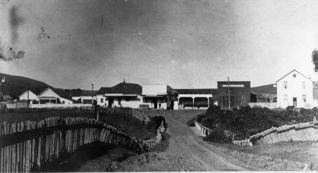
SG.jpg (Photo: The gateway to early San Gregorio).

Is it possible that the same land was sold twice? As to whatever actually happened—and who paid whom—and for whatever reasons—an intriguing document painted a confusing picture.

The document revealed the handwriting of one person using pen and ink on legal-sized paper. The paper had yellowed and turned brittle with age and a chunk had been chewed out of the right margin. A heavy-duty string bound the fragile papers together.

The folder contained “evidence� of a confusing story that pointed to shady dealings over the ownership and sale of the original 17,800-acre Rancho San Gregorio, south of Half Moon Bay.

Covered were transactions occurring between 1853 and 1861—a tumultuous period in California’s history when land was fast changing hands from the rancheros to the American gringos.

…To Be Continued…

Photo: San Mateo County History Museum located in the historic Redwood City Courthouse.. Please visit the museum and research your favorite subject in the archives.

Comments off

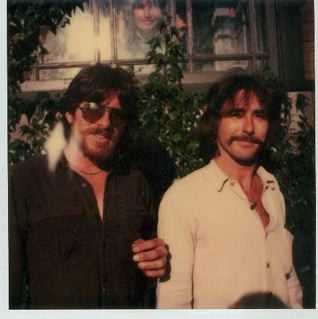
I’ve Always Loved This Photo

of Half Moon Bay building consultant Chad Hooker, wearing the shades (at left) and local beloved character, Jack King, who could recite the finest poetry at the drop of a hat. Word for word. Perfectly. If you look closely you’ll see my face behind the glass. This shot was taken at my house in the 1970s.

Chad1.jpg

Comments off

DSCN0621.JPG

Comments off

Race To Electrify The South Coast: Conclusion

As the official victor in the race to bring light to Pescadero in 1925–Great Western again petitioned the San Mateo County Board of Supervisors for a new franchise. Great Western was then working at Colma, where, according to the Half Moon Bay Review, the power company was “strengthening its poles, making it possible for them to carry 44,000 volts to Half Moon Bay where a substation is to be built…

“When all the new construction is completed, at a cost of approximately $2 million, [ed. can that figure be right?], the Coastside, including Half Moon Bay, San Gregorio and way points, will receive electric service equalling any city in the nation.”

Winning the race bestowed Great Western with a high profile and new purpose. The company donated the services of its legal staff to help secure the right-of-way of the abandoned Ocean Shore Railroad for a scenic highway. Great Western also granted the services of one of its leading engineers, W.J. Walsh, to help improve Pedro Mountain Road.

In December, 1925–as PG&E concentrated on buying out smaller power companies all over Northern California–Great Western was finally granted permission to extend itshigh tension wires from South San Francisco to Half Moon Bay.

Then–a strange twist in the tale.

Just when Great Western appeared to be in total control of the Coastside’s light and power, the company sold its interest in the South Coast, including San Gregorio and Pescadero. The buyer was PG&E!

Great Western was soon to bow out of the electrical business on the Coastside altogether. Again, PG&E was the buyer.

In this ironic turn of events, the loser of the race to Pescadero emerged as the winner who took all.

Comments off

Custom-Made Table For The Famous Magician & His Artistic Wife

CustomTable.jpg

Photo: Table designed/built by John Morrall
C&C.jpgPhoto: Corri & Channing.

The magician Channing Pollock and his artist wife, Corri, had this beautiful, round table designed for their unusual Moss Beach house. The table was in their bedroom, with views of the Pacific Ocean, a place where they most often entertained their many friends. The table was set into a “pit” at floor level. The seating around the table was covered with the wall-to-wall rug.

Comments off

The Race To Electrify The South Coast: Part III

Review.jpgPhoto: The old HMB Review office. Is that a power pole in front?

…In the late summer of 1925 the Half Moon Bay Review devoted plenty of space to the race between Great Western and Pacific Gas & Electric Co.– the two power companies engaged in, well, a power struggle, to see who could electrify Pescadero and San Gregorio first. Beginning the work of planting poles in different parts of San Mateo County, Great Western was declared the winner, having lit the first light in Pescadero 24 hours before PG&E….

For decades there had been a subtle competion between Half Moon Bay (the “metropolis”) and Pescadero (the little village). There were some in Half Moon Bay who looked down on the Pescaderans–who were roundly criticized in the paper for not painting the fence around the old cemetery. In my opinion, Half Moon Bay could act a bit snooty when it came to their neighbors on the South Coast.

In 1925 the Half Moon Bay Review’s editor wrote: “Scarcely had the electric current reached their town, the inhabitants started a movement to have a street lighting system. Pescadero is without doubt populated with boosters, who never overlook an opportunity to advance the welfare and profess of their city.

“Only a short time back, they saw a bank and post office building erected on their mainn street, just at present a new high school is in course of construction.

“But still their desire for advancement in proding them, and ere long they will enjoy the evening walk along their electrically lit streets.”

Barely able to contain their curiosity about how Pescadero looked under electric lights, a headline in the Review read: “Pescadero. We’re Coming”.

The excuse was a meeting of the Coastside Civic Union to be held in Pescadero.

“….there will be at least several auto loads from this point alone,” the Review article warned. “Everyone is anxious to see Pescadero with her new ‘crown of jewels’–the town should fairly shine with the juice from two great systems running into the veins of the community. In other words, the town will really be ‘lit up’….”

…To Be Continued…

Comments off

Please Help Elizabeth Wolffe Find A Job On The Coastside

Dear June,

I happened upon your site as I was looking for employment on the Coastside. My name is Elizabeth Wolffe and I currently live in Foster City. I lived with my former husband , my daughter and two HUGE dogs in Moss Beach for eight years before moving to FC. Since the move we have adopted our amazing and wonderful son, my awesome daughter has gone off to college (Univ.of Washington, because the weather reminds her of HMB), I have gotten divorced (thus the ‘former’ status of husband /wasband!) and I am planning to move back to the Coast I am also looking for employment opportunties on the Coast. I know you don’t ‘do this’ but was wondering if you know of any job openings on the Coast? I have been in the Human resources field for over 20 years…but I am willing to explore other horizons to live and work on the Coast. I appreciate your sincere consideration and most importantly I have loved reading your wonderful stories about the Coast and its inhabitants! Thank you and all the best. Warmly, Elizbeth Wolffe

Email: e_wolffe@yahoo.com

Comments off

My Dad Lost His Battle With Cancer in 1992,

14 years ago today. He was 84. I loved him so much. A gentleman, a gentle man.

dad.jpgMe.jpg

Comments off

The Race To Electrify The South Coast: Part II

THUS FAR: In the summer of 1925 a most unusual “race” took place on the Coastside between the arch-rivals Great Western and Pacific Gas (GWPG) and Electric (PG&E). The two power companies agreed to compete to see who could get power poles to electricity-starved Pescadero first.

For PG&E, the starting point was in the magical redwood forests near La Honda. From there, PG&E crews labored up and down the steep grades, drilling holes for power poles.

Following the rugged coastline, and employing two dozen men in three crews, Great Western started work at Lobitos Creek, south of Half Moon Bay.

Some 400 poles were shipped by boat from San Francisco to Pigeon Point–once the site of a busy wharf.

For three weeks, the crews toiled, day and night. At 4 a.m. on July 16, 1925, an exhausted GWPC crew brought the first electric current into Pescadero–and were proclaimed the victors. The Great Western workers had beaten the PG&E crew by 24 hours.

The winner installed a temporary generating plant in the Roy Scott garage in Pescadero.

According to the Half Moon Bay Review, it was not likely that the power companies’ only interest had been in providing Pescadero with power. More likely it was symbolic of a larger struggle.

“Rumors of a corporation battle for control of the electrical supply of the coast region of central California have been frequently heard,” explained the Review, “but there has been no official word that would verify this.”

The race to Pescadero would not end the struggle. PG&E, “using their own power,” showed an educational silent motion picture ont he screen at the Community Center building in Pescadero.

“Both companies are building parallel lines on the streets” of Pescadero,” the Review reported. PG&E was extending its lines to Davenport while Great Western was heading toward Butano Canyon.

A few days after the race to Pescadero ended, the Review wrly commented that the new lights had “spoiled” the Pescaderans– long accustomed to a rustic lifestyle.

…To Be Continued…

Comments off