Better at everything they do. The on flight toilets are immaculate (!!!)– as are the leather seats and aisles. The on board air feels fresh; there’s no fear of catching the flu… Plus they don’t serve the usual, stinky, horrible food–they don’t “do” food–instead they offer wrapped snacks– and everybody pitches in to make sure they leave the plane in the super-clean condition it was when they boarded.
As for boarding, no problem. No stress.
The ride to and from New York was great. and the landing perfect, no gripping the arm rests, no screechy sound of too much friction when the tires meet the runway. No white knuckles.
Neither Burt nor I enjoy flying–and would rather not–but they made a 6-hour flight as painless as possible.
Iâm back from a short visit to New Yorkâand it never fails to stun me with itâs you-never-know-whatâs-going-to-happeness.
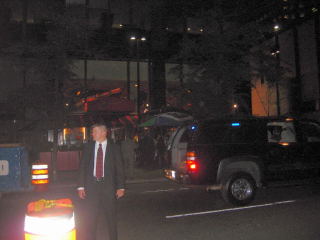
Take Sunday night (Sept 17)– we were dining at Milos, a delicious Midtown Manhattan Greek seafood restaurant, when the street grew noisier than normal outside and the darkness was punctuated with strobe lights⦠Cop cars with lights flashing trailed by an imposing line of black SUVS and limosâ¦.obviously something very hot was going on because the moving entourage stopped outside my restaurant.
The cop cars that were at the head of the line closed the street at one end where earlier in the day a movie starring Will Smith (âI Am Legendâ?) was being filmed.
Now it was very dark outside.
Out of the SUVS stepped the highly professional security guysâgrey suited & beefy– walking every which way– but it soon became clear that the focus of their attention was the Italian restaurant directly across the street. Colorful tent-like umbrellas hung from the ceiling. Was it called Coco?
I saw the backs of a small group of people, men and women, escorted quickly through the doors.
Right away I knew it was related to the big and controversial United Nations meeting about to take place.
Soon the SUVs pulled over and parkedâeven though it was a deep black outside I could see the guys holding the big weapons.
I dashed out of the restaurant to do research. I had to know what was going on. I did shoot some photos out of Milosâ windows– but the hoopla outside, the flashing lights, was too much competition.
On the street I found out security was polite but they werenât talking.
âIâm just hired to work here; I donât know what the job isâ? one muscular guy told me. He was wearing a beautiful suit with the little button on the collarâlike the one they wear in the moviesâand maybe talk into.
Meanwhile, curious onlookers had gathered and were talking among themselves. I joined them to find out what they knew.
âWho is it?â?
âI heard itâs the President of Lebanon,â? one man said.
âItâs the head of Italy,â? said another.
âWhat kind of restaurant is that?â? a woman asked pointing across the street.
Somebody said, “Italian”.
âItâs over-priced,â? said another.
“We pay for it.” Was I the one who said that?
It made us all laugh.
(In fact, when I later walked over to check out the menu, I discovered that it was not an expensive restaurant at all; the entrees were moderately priced).
With too many unanswered questions, I walked over to one of the guys holding what might have been an AK-47 type weapon–he was sitting in the back of an SUV, with the back down. Actually pretty scary but I couldn’t resist.
âWhatâs going on?â?
âIâm not in a position to answer you,â? he said.
âBut I gotta know; just tell me this, is it UN-related?â? I can be very persuasive.
He nodded. Ahhhhâ¦a second of satisfaction. I took a deep breath. Part of the mystery had been solved–bit was it?
I was on a roll and moments later I got the real scoop. I found someone willing to answer my question.
âWhatâs going on?â? I asked again.
âItâs the President of Iraq. Heâs eating dinner in there right now.â?
Triple Ahhhhhâ¦..My curiosity was sated, I could finally relax.
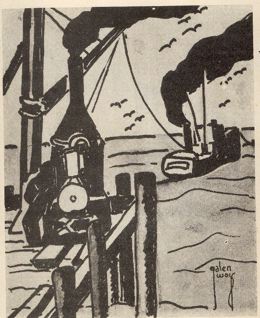
“The pier at Amesport is one thousands feet long. Here at the double warehouse Wm. Mullen greets you, the loads are weighed. The low cars roll slowly down the grade of the wharf. A steady horse immune to the scare of breaking waves beneath, follows the cart to draw it back.
“Other wagons come from the north. From the ranch of Guerrero, at the foot of Pedro Mountain. The Burkes come in. Deany, Draffen, Dennison, John Kyne, Murphy. There will be a load for the little steam schooner rolling at her anchor fifty feet beyond the pier.
“The donkey engine clanks. The slings lift high. Your potatoes appear on the deck of the schooner. The men work fast, to clear the way for the waiting boats.
“You shake hands with John Mullen, with Ring and Casey.
————————————————————————————————————————
“It is too late for the stage. You walk along the cliffs south of town to pass the afternoon.
“Godetia and wile aster and clean shining strawberrries garden the banks. A rich, drowsy smell comes from the new mown hay, and it is spiced with tarweed. You breathe deeply.
“The beaches far below are swept clean as carpets. Gulls float by. At sea the murres are flying in an endless phalanx from south to north. This will go on all day.
“In the bay a whale breaks the surface. The cry of sea lions comes from the Sail Rock of Pillar Point.
“Over the sky a silver veil has crept. The hay fields are a dusty gold, and the half seen hills a soft and smoky blue. The sea breaks with a hollow sound and the sea birds scream.
“To the west a grey shape passes. It is no doubt the steam schooner. But it could be anything. The ghost of a ship that had lost its way in the fog and wrecked. Now its whistle blows, a voice hoarse and unbelievably wild.
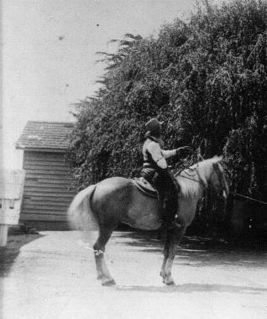
“In the hay field a horseman is riding. No particular somebody. But in the glorifying light, and in your wish, it is Pablo Vasquez on the golden pony.
(Pablo Vasquez and his golden horse).
“For a spell has been about you since first you glimpsed the coach in San Mateo. The magic reaches you now with great force. There is no distinction of time remaining. Either of the day or of the year. The gentleness of the land has overcome you. Here is the long sleep. The long dream.
“You will carry some of this back to the busy city streets. You will carry a bit of it all your life. For the dream is fadeless, the heritage of those who know and love this land.”
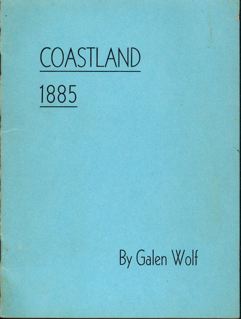
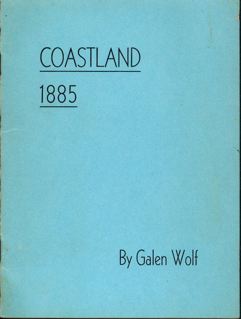
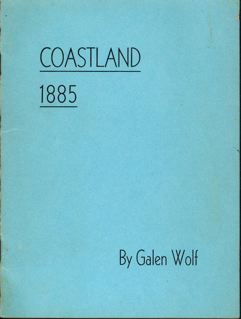
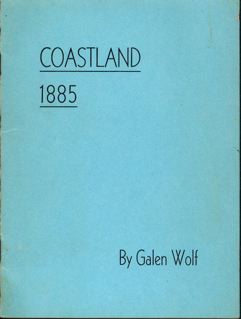
Note: “Coastland 1885” by Galen Wolf was published to commemorate the 90th anniversary of Levy Bros, founded in Half Moon Bay in 1872.
“Pablo Vasquez, slender, grave,white head and beard, unbelievably poised and graceful. And his golden pony. Little hooves flicking like white butterflies, golden skin polished and glinting in the sun. They pass. An era passes on those twinkling hooves.
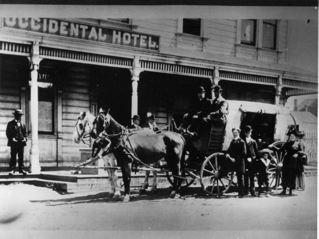
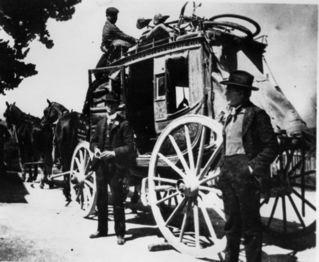
“The stage draws up to the porch of the Schuyler House. Quick leaves, hand shakes, and you board it,climbing to the high seat beside Bob Rawles.
Wells Fargo’s box lies at your heels, and the reins of six horses, complex and demanding, are in Bob’s hands.
“You look at his seamed and weathered face. He is no longer young. Soon Eddie Campbell and Frey of Purissima will drive, and old Bob will linger at the stables, unable to leave the animals he has handled so long.
“From your high perch you survey the homes, the picket fences, the bursting, overflowing gardens. This is the land of the fuchsia, the geranium, the nasturium.
“Against the quiet neutrality of the sky and green-grey lands, the flowers flame with a passionate glory.
“The homes look loved and well cared for. The contentment reaches you on the high seat and you are happy.
“The hay is a long sea before you. Occasional fields of flex are heliotrope lakes. Eucalyptus and cypress fence the farms with sheltering walls.
“Purissima beckons, but Irish Ridge is your destination. There are the fields of potatoes for hungry San Francisco. This is your business today.
“A road winds steeply and curves from sight. Goldenrod and wild aster border it. You leave the stage and look forward to the climb. But here is John Ring, with his team behind you. You ride.
———————————————————————————————————————————
“On Irish Ridge, the fiddles sing. The merry quips and laughter ring. At night the lads and lassies dance. The old folk dance the clog.
“On Irish Ridge are Garrigans and Rings. On Irish Ridge the Caseys live like kings.
“The dusk of the dawn is in the barns as leather is flung on sleepy horses. In lamp-lit stalls the bit, collar and harnass are fitted. In the quiet of the morning, you are on your way to Amesport [ Miramar Beach].
“Six wagons are coming. Loaded high and heavy with potatoes. Kinds unknown today; Bodega Blues and Sonoma Rose and Peerless. Blue shirted, big-framed men quietly handled the teams. It is a land and a time of horsemen.
“Up through dusty miles. Dust in little cataracts falls from the wheel rims.
“On through the half-wakened town. Northward, where the whistle of an impatient steamer blows.
“You know the man speaks the truth. Across the Peninsula, a few dairies lie scattered from Colma to Redwood. Although it is a county seat, Redwood is just emerging from the prevailing marshland.
“Here on the coast is vigorous, bustling life. Two stage lines serve the coastland and the traffic is phenomenal. Sometimes three steam schooners are waiting their turn at Amesport.
“Wheat, potatoes, cattle, hay, flax and timber pour out to nourish the new growth of San Francisco.
“The Steeles, Moores and McCormacks farm all the way to the Santa Cru county line. Doble, Dowell, John Mein, Deany, Schult and Martin are at Lobitos, at Tunitas and Purissima. The latter boasts a hotel, a store, a dance hall, a saloon, a school and a church. Fishermen from San Francisco know these streams well.
“Irish Ridge is populated. Rings, Garrigans, Casey and O’Briens have built there, high above the sea.
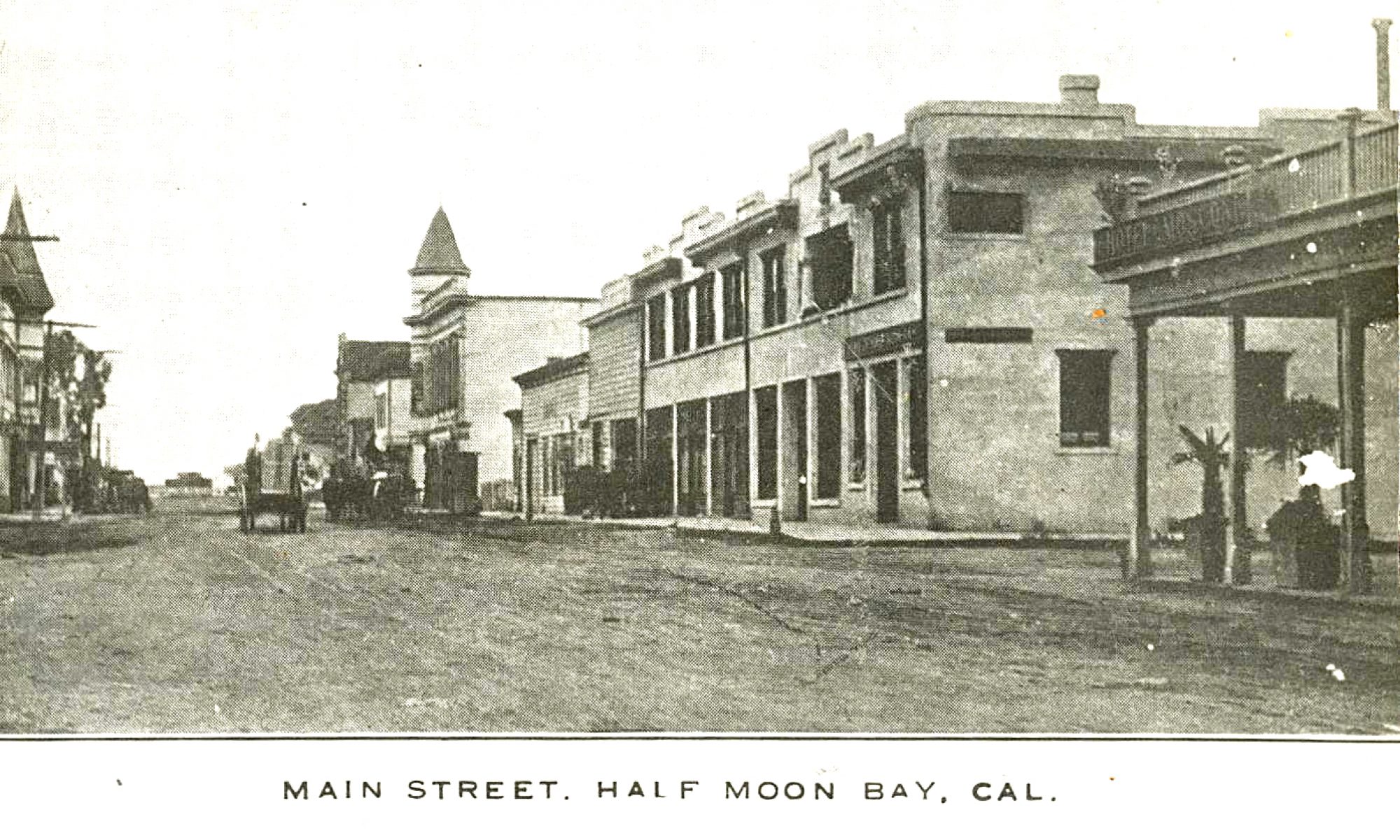
“Halfmoon or Spanishtown, throbs with life. Its stories, schools, churches and saloons are all patronized as occasion calls.
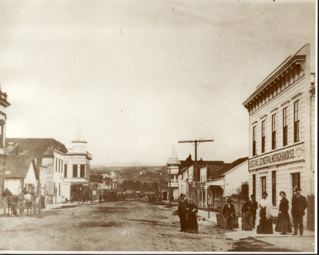
“Bolts of cloth are piled to the ceiling in Levy’s store and Boitano’s. The barns bulge with grain. Team after team crawls up and down Main Street.
“Mary McCormack and Miss Pringle and Clara Mullen have their schools.
“And on Sunday, the workaday community quiets to a hush. The church bells call their singing cadence. Almost to a man, woman and child, the town turns out.
“As you stand on the porch of the Schulyer House, you can see across the grainfields the mouth of Higgins Canyon. Sanor and Tom and Wm. Johnsonn farm theere, and Clement Nash. The hill of Rudolpho Miramontes is a waving backdrop of grain beyond the town streets.
“A six horse team strains at the tugs as it starts a load of lumber. It hass three miles to go to the long pier at Amesport.
“There will be more of these teams soon. Charlie Borden and Rufus Hatch are cutting in the Purissima. Hughes at Tunitas, Walker, Bloomquist and a score of others in the San Gregorio, the Pomponio, the Pescadero. The walls of San Francisco are being created.
“Behind you the election talk simmers. Now local pride has its hour. A man tells of the running of Andy Younker from San Francisco with a fifty pound sack of flour on his back. He made Amesport before dark and won his wager.
“You hear of Louis Cardoa who carries two sacks of grains at a time to the boats and earns two men’s wages.
“You hear of Wm. Griffith. He bought the first lot in 1862. It seems he has again won the turkey shoot with frontier markmanship.
“And then, visual focus of their pride, a horseman rides by. He rides simply, without ostentation. But here is drama living.
“The Emperor’s Children” by Claire Messud, which I’m still reading and can’t tell you about–except that I love it so far–didn’t make the cut from the longlist to the shortlist of the British Man Booker Award–which is akin to the American Academy Awards–well, sort of. My impression is that the judges just don’t like America–the author Claire Messud lives in Massachusetts. You have to have ties to England and/or the old British colonies to be in the running. I’m telling you, this is a great book.
“And now the town. A tall white church, new and imposing. A store, and a store, and a store. Joe McCarthy’s, Angelo and Joe Boitano’s emporium. The headquarters of the Levy brothers; Ferdinand, Joe, Armand and Adrian, from Alsace Lorraine. And their wives from a German merchant port. They had come to serve and to prosper and they are doing both well.
“On the right, on Kelly Avenue is Nelson’s livery stable. Harry the post carrier, is still to be born. The postmaster is Fred Valedejo. Here is Quinlan’s blacksmith shop. There, Charlie Gonzales’ forge, showering sparks and tinkling with hammer blows.
“Now neither rawles nor the horses are too tired for the expected dramatic finale. Bob brings the team to a spanking trot. With a roar of wheels, a grind of brakes and trampling hooves, the stage comes to a hard down stop in front of the Schuyler House.
“The Schuyler House looks down from four impressive stories and balconies. A few years before it had been sold to a corporation of ten, at a thousand dollars a share. So now in the bar is young Andy Gilchrist. And in charge of the kitchen is young Kate Burke.
“They are to have many years of marriage and hotel keeping before them. But the years of the foredoomed Schuyler House are to be few. On April 26, 1894, it is to vanish in an avalanche of flame and thundering fall of roof and floors. Charlie Walker’s drug store is to be burned too, and the whole town threatened. Half Moon will fight back desperately with buckets and will never forget that day.
“You clamber a bit stiffly from the stage. The strap bound Wells Fargo box plummets to the board sidewalk. Not always has it survived the journey. The stage is not the only institution of the West to travel that lonely road. There are highwaymen too.
“On the hotel veranda you see the Higgins boys. Also McGovern, Clement Nash and Wm. Savage. You see splendid Dr. Church, and towering alongside him Johnny, all eight feet and one inch of him, the tallest man in America.
“The passengers separate to the bar, the dining room, to their homes. New passengers arrived; John Mein for Lobitas, some for Irish Ridge and for Doble’s ranch at Purissima. Three drummers are going through to Mc Cormack’s new hotel, the Pescadero House, and one to the Swanton House.
“Here they will take the Sears stage through the heavy timber to La Honda. Up and down the terrific Upenuf dusty grade to the Trippes store at Woodside and thence to Redwood City.
“It is a jolting, bone-weary job the drummers have, but with a pint of whisky and big black cigars they will see it through.
“After dinner in the bar, there is quite a gathering. It is nearing election. The strong voice of Judge Pitcher asserts, ‘As goes Spanishtown, so goes the county.’ A cheer goes up. The new name, Half Moon Bay, is yet strange to say.
“The horses strike up a trot. You feel the ride will be too soon over, a delusion that will fade as the mountains slow the journey to two hours, or three if the road is badly out. Then the passengers must perforce dismount. And walk. Or push. Or pluck pickets from a nearby fence and pry the suddenly stubborn wheels from one deep hole into another.
“The hills part. A gate in the canyon rises on either side. Men are working, clambering, sometimes rope-supported from above. ‘That’s Herman Schussler’s gang preparing for the new concrete dam. It will make a lake of the whole Spring Valley’.
“There is a short stop at Crystal Springs House. Ax men are setting up camps to clear the trees from the lake bed to be. The road soon mounts. The horses walk.
“The hills are green-grey with varied brush. The yellow flowers, the lupines, the primrose, wormwood and mimulus dust the slopes with gold. The sun draws rich odor from aromatic plants and from the yerba buena.
“Suddenly a breath of air comes cool to your face. The scent of the sea is on it. Refreshing and exciting,. You are nearing the top of the grade.
“Now the whole world slopes westward to the sea. Far down a canyon checkered with cultivation the sun picks up the white of houses and of a tall church.
“Bob Rawles has his foot on the brake, the leather hub shuches and squeaks. The horses break into a trot. The coach rocks and rolls.
“Nearly straight below you see the roofs and the golden pumpkin patches of Albrecht.
“Beyond this the canyon opens. ‘That’s where a bear treed old man Digges. He came ahead of the wagons. They had to ground brake them down the hill. No road then. Digges sat in an alder. The bear sat on the bank. Real patient. Till the wagons come. And someone shot him.’
“The road is proving good. It is summer, the stage rolls past the adobe of the Campbells. There the boy Eddie waves, and waits for his day on the driver’s seat to come.
“The next adobe is Fred Fillmore’s. You are nearing town. Here is the Catholic cemetery. Here is Gilchrist’s creamery. Ahead is the piled bridge that spans the Pilarcitos.
“On the right, the long, low adobe of the Vasquez family. Daturas bloom against its walls, and marguerites, yellow and white, crowd the yard.
“a horseman is quietly riding out on a golden pony. Only his white beard tells you he is not a youth. He is instead a centaur. He is Pablo Vaquez. Legend had many tales of him. Did he ride with Murieta? Who knows….
….To be continued…
Photo-courtesy San Mateo County History Museum. Visit the museum at the historic Redwood City Courthouse–or better, yet, become a member!